Incident reports, concern records, and safety observations influence nearly every part of an EHS program. The information captured when an event is first reported often becomes the foundation for investigations, corrective actions, and operational decisions that follow.
In day-to-day operations, however, documenting issues rarely happens under ideal conditions. Frontline employees are often reporting concerns while managing ongoing work, moving between tasks, or responding to incidents in real time. Across large organizations, reports are submitted by teams with different levels of experience, writing styles, and language preferences.
As a result, reporting quality can vary widely. Some records include detailed context and clear descriptions, while others contain limited information that leaves important gaps in the record from the start.
Why Description Quality Affects Every Stage of EHS Programs
Reporting gaps create challenges long after the initial report is submitted. Investigators may need additional clarification before they can move forward, corrective actions can take longer to validate, and review cycles become more time-consuming across teams.
Description quality also shapes how effectively organizations identify trends and recurring risks. Similar events may be documented differently across teams, making operational patterns harder to recognize and reducing consistency in how risks are evaluated.
Over time, these inconsistencies affect the reliability of operational data used to support prevention efforts, root cause analysis, and continuous improvement initiatives.
How Describe It AI Works in Real Live Operations
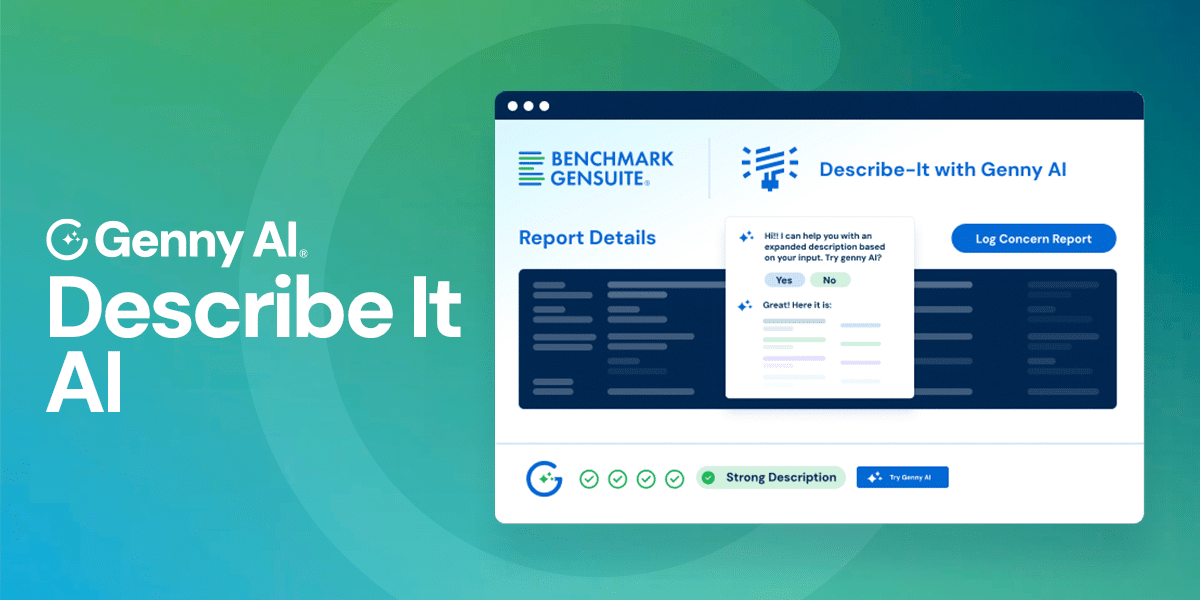
The Genny AI Describe It AI Advisor is embedded directly within Benchmark Gensuite workflows and activates as users begin entering descriptions into supported applications. It follows a structured, real-time process:
1.- Analyze descriptions as users type
The Advisor evaluates narrative quality in real time, reviewing clarity, completeness, descriptive language, and relevance as information is entered.
2.- Provide immediate feedback and guidance
Users receive suggestions that help strengthen descriptions, including prompts for missing details and recommendations for clearer phrasing.
3.- Assign quality scores dynamically
Descriptions are evaluated using a weighted scoring system that updates as users refine their entries, helping teams understand what stronger reporting looks like.
4.- Support consistent reporting across teams
Multi-language support and standardized guidance help improve consistency across sites, regions, and reporting experience levels.
5.- Improve downstream workflows
Higher-quality descriptions support faster investigations, more effective corrective actions, and stronger trend identification across records.
Changing Day-to-Day Reporting for EHS Leaders
For many organizations, improving reporting quality traditionally requires significant review and follow-up effort after reports are submitted. Describe It AI shifts that process earlier by helping teams strengthen records while information is being captured.
Organizations using Genny AI capabilities have reported description quality improvements from an average score of 3 to 5 out of 6, helping teams submit clearer, more actionable records from the start. Reducing clarification cycles also supports faster investigations and more efficient corrective action workflows.
Because Describe It AI is embedded directly within existing Benchmark Gensuite applications, teams improve reporting quality without changing how they work. Guidance happens in real time, within the same workflows already used for incidents, concerns, inspections, and actions.
Built to support frontline teams and EHS professionals, this tool improves reporting quality while keeping judgment and decision-making with the people responsible for managing risk and operations.
See the Genny AI Describe It AI in Action
Explore how real-time AI guidance helps teams create clearer, more complete incident and concern reports—supporting faster investigations, stronger trend visibility, and more consistent reporting across operations.