Why Operational Platforms Become More Important in the Age of AI
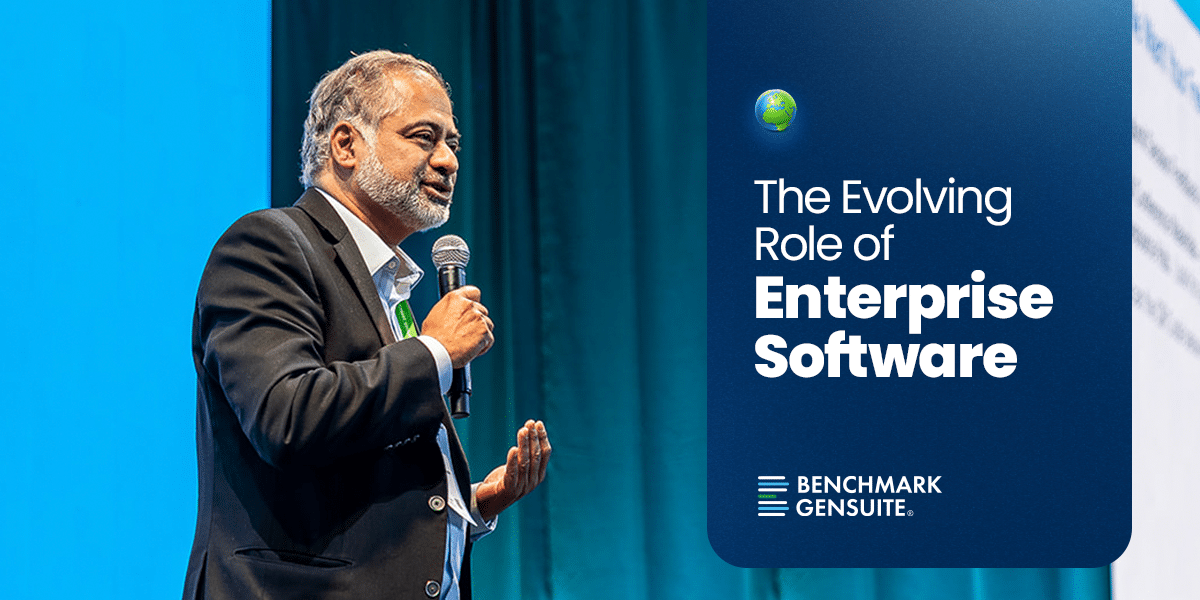
By R. Mukund, Chief Executive Officer, Benchmark Gensuite
Benchmark Gensuite is a critical enterprise system for operational risk management. For our subscribers, that has always meant considerably more than managing data. It means a trusted operational platform that standardizes how organizations manage safety, environmental performance, sustainability, quality and operational risk across the enterprise—bringing together workflows, policies, governance, operational data and institutional knowledge in a single system that scales across business units, geographies, languages and operating environments, and that serves the frontline worker executing a daily task no less than the executive accountable for enterprise performance.
That is what a critical enterprise system should do.
Agentic AI is now reshaping how work is performed across the enterprise, and it would be reasonable to assume that systems of this kind matter less as a result. The opposite is true. Not because AI replaces them, but because AI magnifies both their need and their value.
For decades, enterprise software has asked people to understand the application before they could use it well.
Users learned navigation, understood workflows, knew where information lived and interpreted reports before deciding what action to take. That interaction model is now changing, and quickly. People increasingly expect to ask a question, describe a problem, capture an image or request an action in natural language, without first having to understand how the software is organized or where information is stored behind the scenes.
The technology should make interacting with enterprise systems easier. The enterprise system should continue to manage the business process. That distinction is more consequential than it may appear: artificial intelligence should simplify access to operational knowledge, not replace the operational systems that generate and govern it.
In practical terms, it means someone should be able to ask, “How many management of change requests are currently open?” or “Show me the incidents awaiting investigation,” without specialized technical knowledge and without any understanding of how the application is structured.
The operational platform already knows the answer.
More importantly, it understands the business process behind the answer—the relationships between records, the workflows that govern them, the permissions that control access and the operational context that gives the information its meaning. That is the value of a critical enterprise system, and artificial intelligence should make those capabilities easier to access rather than bypass them altogether.
The harder question, though, is interoperability.
As organizations adopt different AI assistants and enterprise technologies, they will inevitably run different models, different assistants and different ecosystems, often several at once and rarely by deliberate design. Enterprise software must be able to participate openly within those environments while continuing to preserve governance, security and operational integrity.
This is where the Model Context Protocol (MCP) represents an important advancement. MCP provides a standardized way for AI agents to interact with enterprise systems through governed interfaces, rather than requiring specialized IT expertise with APIs and custom integrations for every new assistant an organization brings on. What that permits is meaningful: retrieving operational information, updating records, initiating workflows and interacting with enterprise business processes through natural language, all while continuing to operate within the governance the organization has already established.
The protocol itself is not the destination. Open interoperability is.
Our responsibility is to ensure that the operational capabilities our subscribers rely upon every day can participate securely within whatever broader AI ecosystem they choose to build. That philosophy has guided our investment in APIs for many years, and it extends naturally to technologies such as MCP. As organizations continue adopting agentic AI, enterprise software should become more open, more connected and easier to interact with—without compromising the governance and operational discipline that enterprises require.
This, in short, is the next evolution of enterprise software.
As enterprise AI becomes part of everyday operations, trusted operational platforms will not recede into the background. They will become primary enterprise systems—the governed foundation through which intelligent assistants retrieve information, initiate workflows and help organizations manage operational risk.
The future is not a matter of replacing enterprise systems with AI. It is a matter of enabling enterprise AI to work through trusted operational systems that already understand the business, the processes and the governance behind every decision. And the organizations that realize the greatest value from AI will not be those that simply deploy the most intelligent assistants; they will be those that connect those assistants to the primary enterprise systems already running their business.
That is the future we are building toward at Benchmark Gensuite.