For many EHS organizations, collecting safety data is no longer the challenge. The harder question is what happens next.
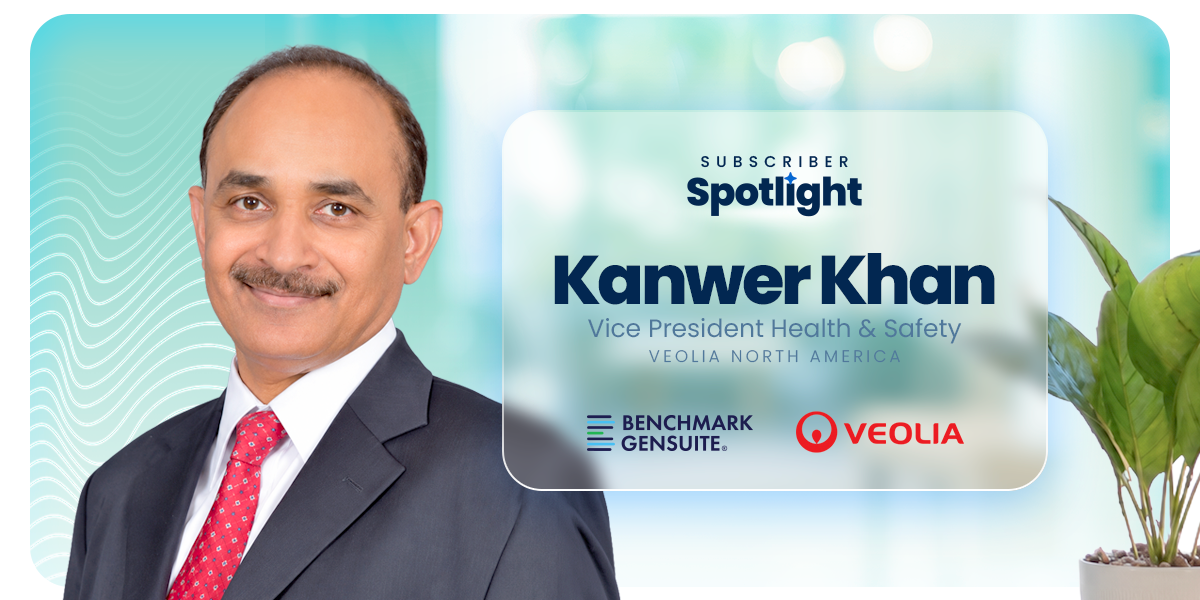
Veolia North America knows that challenge firsthand.
Several years ago, the company launched an aggressive effort to increase employee participation in leading indicator reporting. The initiative worked: Veolia now sees approximately 30,000 to 35,000 leading indicators reported in a typical year.
But more data didn’t automatically mean better intelligence.
“We were collecting a lot of EHS data, however there was no useful outcome of all that data collection,” says Kanwer Khan, Vice President of Health & Safety at Veolia North America. “We were looking for a business intelligence tool.”
For Khan, who has spent 35 years in EHS, the opportunity goes beyond digitizing safety processes. His vision is to connect employee reporting with better risk intelligence and leadership action—and ultimately rethink how organizations measure safety performance.
Veolia’s challenge wasn’t a lack of employee participation. It was extracting meaning from thousands of observations.
“They’re all data points. They go into a black box and no one has a clue of what to do with that data,” Khan says.
Veolia could measure the number of leading indicators reported per employee, but that metric alone couldn’t tell leaders where meaningful risk existed or tell employees what happened as a result of their reporting.
“That from a business intelligence standpoint didn’t help us in making any decisions, didn’t tell us where our risk was … and it didn’t give any information back to the person who reported it.”
For Khan, this isn’t simply a data analytics problem. It’s an employee engagement opportunity.
“If employees report things and they don’t see anything is done to that, they will stop reporting.”
The goal is a feedback loop: employees report what they’re seeing, the organization converts that information into actionable intelligence, leaders respond, and employees see evidence that their participation matters.
That also points toward a different operating model for EHS.
“What we’re trying to do is to take the safety team out of this process and have employees and executives work directly. And safety becomes a coach or a technical resource, which both sides reach out to for getting technical advice, but don’t drive the process.”
Rather than having EHS professionals own every aspect of reporting and data management, operational leaders should take ownership of safety performance, while EHS provides the expertise needed to understand risk and determine the appropriate response.
Making that model scalable requires technology capable of processing enormous volumes of safety information.
Before transitioning to Benchmark Gensuite, Veolia exported records into spreadsheets, manually categorized events, and experimented with generative AI tools to identify patterns. The process was labor-intensive, and the information could be losing its operational relevance by the time an analysis was completed.
During the first six months of 2026, approximately 600 events at Veolia were reported as high potential. After manually reviewing them, the team determined that only 10% represented true high-potential severity events.
Before converting to Benchmark Gensuite, Veolia provided its data to Benchmark for evaluation using Risk AI Advisor. Khan says the Risk AI assessment had an 85% match with Veolia’s manual analysis.
“That gave us a high level of confidence.”
For Khan, the result was an important factor in Veolia’s decision to transition to Benchmark Gensuite. It demonstrated the potential to make risk intelligence an ongoing part of the EHS process rather than periodically extracting and manually analyzing large data sets.
Veolia is also using Describe-It AI Advisor to improve the quality of the information being reported in the first place. Better input and faster analysis create the opportunity to get actionable information to leaders while it can still influence decisions.
Explore how Risk AI Advisor helps EHS teams evaluate safety data at scale and identify meaningful risk.
Better risk intelligence raises a bigger question: Are EHS organizations measuring the right things in the first place?
Organizations can look at injury rates, training compliance, behavioral observations, concern reporting, stop-work activity, high-potential events, SIF/pSIF indicators, and other measures. Each tells leaders something, but none necessarily provides a complete picture of risk at a particular operation or site.
Khan believes the next evolution could be a blended risk metric: an aggregated measure combining a carefully selected group of leading and lagging indicators, appropriately weighted, to give leadership a clearer representation of operational risk.
The concept could help answer a deceptively simple question:
If injury rates aren’t the best indicator of current risk, what should I look at instead?
But even predictive measures such as SIF and pSIF reporting depend on employees actually reporting what they see.
“If you have a culture which is very top heavy and the local manager at that site wants to control everything that gets reported, you will not see any SIFs or pSIFs unless somebody has a serious injury.”
A site with few reported high-potential events might be exceptionally safe. Or employees might not feel comfortable reporting them.
That means interpreting safety metrics also requires understanding the culture producing those metrics. Khan believes organizations need to understand whether employees feel psychologically safe enough to report risks and mistakes openly.
That aligns with Veolia’s broader pursuit of what Khan describes as a “Fair Culture”: based on positive recognition, open reporting, and fair treatment.
A high volume of reporting isn’t necessarily evidence of an unsafe workplace. It can also indicate a highly engaged workforce willing to identify risks before they become incidents. Conversely, very little reporting isn’t necessarily good news.
The question becomes: What does the reporting tell us about risk, and how confident are we that employees feel comfortable telling us what they’re seeing?
Veolia is still early in its Benchmark Gensuite journey, but Khan’s definition of success is clear.
For employees, the platform should provide a user-friendly way to report data, events, successes, and risks, while giving the organization the ability to act and provide timely feedback. For leadership, it should turn that information into business intelligence.
Veolia is now working to expand leadership use of its Executive Dashboard and make EHS information increasingly useful as a business-management tool.
The transformation also required moving away from a mature incumbent EHS platform. Khan’s advice to other EHS leaders is to consider where their organizations want to be technologically five or ten years from now, then evaluate whether their technology partners can support that long-term direction.
For Veolia, one important differentiator was Benchmark Gensuite’s ability to adapt alongside that vision and work collaboratively to develop solutions.
The larger lesson, Khan says, applies regardless of which technology provider an organization chooses:
“Make sure that your long-term vision and their long-term vision aligns.”
Veolia’s journey reflects a broader evolution happening across EHS. Digitization helped organizations collect enormous quantities of safety information. The next challenge is turning that information into intelligence that helps leaders identify meaningful risk and act on it—while showing employees that speaking up produces a response.
When that cycle works, safety reporting becomes more than a metric. It becomes a source of business intelligence and a mechanism for building trust.
Like this article? Share it with your network!
Benchmark Gensuite Blog
Note: Subscriber instances where you have an active registered user account are listed above.
If you need further support, please email us at
getHelp@benchmarkdigital.com
Please include your company name and registered email address so we can assist you.