At IMPACT 2026, one topic consistently rose to the top across executive discussions and subscriber sessions: Serious Injury and Fatality (SIF) prevention.
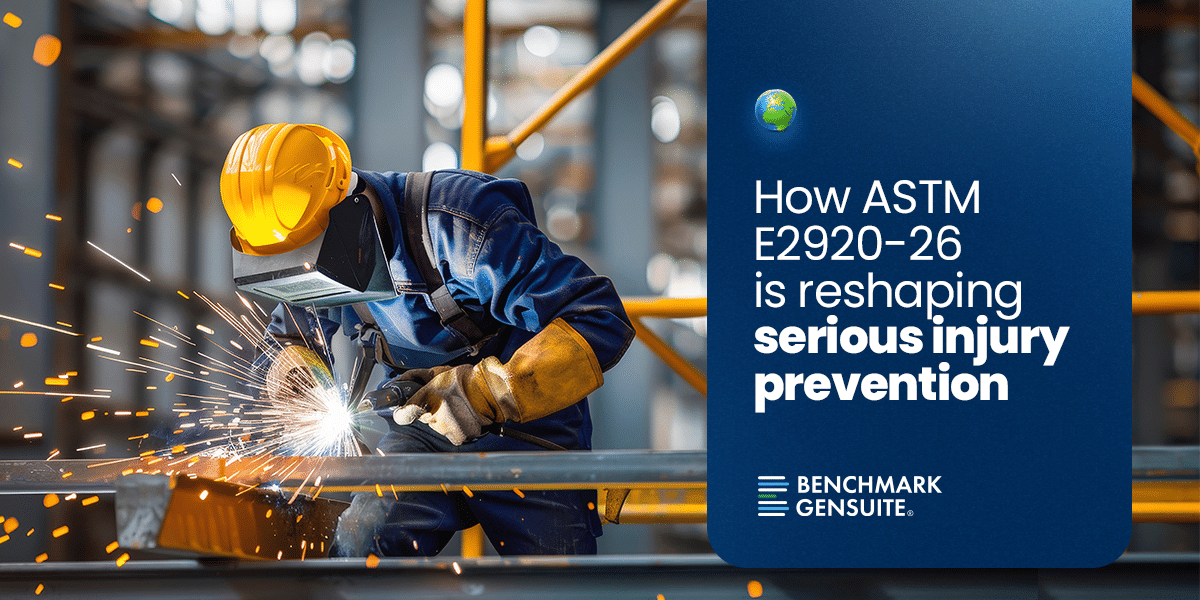
As organizations continue reducing traditional OSHA recordable rates, many EHS leaders are recognizing that low TRIR numbers do not always mean low catastrophic risk exposure. The focus is shifting from simply tracking injury frequency to identifying serious injury potential, precursor events, and operational vulnerabilities before high-consequence incidents occur. That shift is a major driver behind ASTM E2920-26, the updated standard released in January 2026 that provides a more structured framework for incident severity classification and serious injury potential evaluation.
“We’re moving from just tracking TRIR… to looking at what could have happened,” shared Tricia Petty during Benchmark Gensuite’s EHS & Quality Management breakout session focused on ASTM E2920-26 readiness.
At Benchmark Gensuite, we are helping organizations operationalize ASTM E2920-26 through scalable digital workflows, dynamic incident evaluation processes, and AI-enabled incident intelligence capabilities that improve visibility into SIF exposure and support more proactive risk prevention.
Benchmark Gensuite is among the first providers to deliver proven, operationalized ASTM E2920 capabilities within an enterprise EHS platform, not as a concept, but as technology actively being used today by global industrial organizations to strengthen SIF prevention and incident intelligence programs. These capabilities were forged alongside practitioners in the field.
Now, through our active subscriber-led ASTM workgroup, leading EHS organizations are directly helping shape the next phase of our innovation roadmap as we advance dynamic incident evaluation workflows, AI-enabled risk insights, and next-generation SIF-focused incident intelligence capabilities aligned to ASTM E2920-26.
Why Organizations Are Reassessing Serious Injury Prevention
One of the messages from the IMPACT 2026 executive panel was that serious injury prevention is increasingly tied to broader operational risk management, business resilience, and workforce performance strategies.
“The last thing we want is a fatality. SIF identification and having a strategy is super critical,” explained Marty Stern, Vice President of Global EHS at Colgate-Palmolive, which is currently pursuing advanced ASTM E2920-26 alignment initiatives with Benchmark Gensuite.
Organizations are increasingly asking:
- Where are our highest consequence risks?
- Are we identifying precursor events consistently?
- Do our sites classify severity the same way?
- Are we learning from near misses and high-potential events early enough?
Additionally, Allison Montgomery of Applied Materials described how operational velocity and productivity are becoming increasingly important business priorities, and how EHS strategies must align with those broader organizational objectives.
“For us, it’s about velocity and productivity,” Montgomery explained. “How does my strategy help them be more productive and operate at a faster pace? Reducing risk helps them do that.” She also emphasized that organizations are increasingly focusing on higher-level operational controls that reduce overall risk exposure and contribute to reductions in SIF events.
Reducing serious risk exposure and improving operational visibility are increasingly viewed as enablers of sustainable growth, not separate compliance activities.
What ASTM E2920-26 Changes
ASTM E2920-26 expands and clarifies how organizations can classify serious injuries, illnesses, and high-potential events. While many companies have developed internal SIF methodologies over the past decade, ASTM provides a more standardized, outcomes-based structure for defining and evaluating severity.
ASTM also notes that the framework is intended to support more consistent benchmarking, management system evaluation, and continuous improvement efforts across organizations and industries.
More Structured Severity Categorization
The framework distinguishes between:
- Actual Serious Injuries & Fatalities (aSIF)
- Potential Serious Injuries & Fatalities (pSIF)
The framework shifts focus toward evaluating the potential severity of an event—not only the outcome that occurred. This helps organizations improve visibility into precursor events and serious risk exposure while creating more consistent benchmarking opportunities.
Updated Injury & Illness Definitions
The revised framework includes more detailed guidance around:
- Fractures
- Tendon and ligament injuries
- Internal organ damage
- Hearing loss thresholds
- Severe burns
- Concussions
- Amputations
- Occupational illnesses
Greater Emphasis on Consistency
One operational challenge many organizations face is inconsistent classification across sites or regions. Similar incidents may be categorized differently depending on local interpretation, reporting culture, or investigator experience.
ASTM E2920-26 helps reduce that variability through more structured classification logic and work relationship evaluation criteria.
The Operational Challenge Behind ASTM Adoption
Adopting ASTM E2920-26 is more than a reporting exercise. For many organizations, it requires revisiting historical data, reevaluating classification workflows, and aligning multiple stakeholders around updated severity methodologies. As leaders at IMPACT 2026 mentioned, many organizations remain “data rich but information poor,” making consistent SIF prevention strategies more difficult to operationalize.
During the EHS breakout sessions, Benchmark Gensuite subscriber Perrigo shared how their team has been reviewing historical incident data to improve consistency and strengthen future trending analysis for their ASTM E2920-26 initiatives.
Organizations are also balancing multiple reporting priorities:
- OSHA recordability
- Internal severity models
- SIF methodologies
- Operational risk reporting
- Leadership dashboards
- Benchmarking requirements
The challenge is often not the volume of data itself, but the ability to structure, classify, and interpret it consistently enough to support decision-making.
Real-World Adoption & Industry Collaboration
Several Benchmark Gensuite subscribers, including Colgate-Palmolive, Perrigo, and Applied Materials, are already evaluating or operationalizing ASTM-aligned approaches to severity classification and serious injury prevention strategies with the help of Benchmark Gensuite’s EHS subject matter experts.
During the executive panel discussion, leaders described how collaboration across companies and industries is helping organizations align around more consistent approaches to serious injury identification, precursor analysis, and operational learning.
“We started sharing notes and talking about what we’re doing as companies and how we build the connection to the system so that we collect the right data,” explained Marty Stern of Colgate-Palmolive. “The collective power of this group really helps drive better solutions that protect our people.”
How Benchmark Gensuite Is Supporting ASTM E2920-26 Readiness
During the Incident Management breakout session, Benchmark Gensuite shared several roadmap initiatives designed to help organizations operationalize ASTM E2920-26 within their incident management workflows.
These included:
- ASTM-aligned injury and illness classifications
- Level 1 and Level 2 severity logic
- Standardized work relationship evaluations
- Enhanced pSIF/aSIF reporting workflows
- Improved severity trending and benchmarking
- AI-supported incident analysis capabilities
Benchmark Gensuite also demonstrated how AI-supported workflows such as PSI Advisor AI and Energy Wheel analysis can help organizations identify recurring risk patterns and strengthen operational learning earlier in the process.
Rather than treating ASTM as a standalone compliance initiative, many organizations are beginning to integrate it into broader operational risk and prevention strategies.
Preparing for the Transition
For organizations evaluating ASTM E2920-26, the transition process will likely involve more than simply updating terminology inside an incident management system.
It may require:
- Reevaluating current severity classification methodologies
- Improving consistency across sites and business units
- Revisiting historical incident trends
- Strengthening precursor event identification
- Aligning leadership around SIF-focused metrics
- Modernizing workflows to support operational learning
ASTM E2920-26 is becoming part of a broader operational shift toward more connected approaches to incident intelligence, operational risk management, and serious injury prevention—helping organizations better understand not only what happened, but what could have happened, and where prevention efforts can be strengthened before severe outcomes occur.
Resources for ASTM E2920-26 Readiness
Interested in aligning your incident management program with ASTM E2920-26? Connect with a Benchmark Gensuite expert to learn how organizations are strengthening SIF prevention, severity classification, and operational risk visibility.