The responsibilities of today’s EHS leaders extend far beyond regulatory compliance. Alongside protecting workers and managing risk, many are helping organizations navigate workforce shortages, strengthen employee engagement, and improve performance.
As the role expands, businesses are redefining what success looks like. Increasingly, EHS is expected not only to reduce risk, but also to improve operational efficiency, strengthen business resilience, and help companies scale more effectively.
Despite these growing expectations, many EHS teams continue to face resource constraints. According to the 2026 EHS Benchmarking Report, 44% of surveyed EHS leaders cite lack of budget, headcount, or executive support as the number one EHS-related challenge keeping them up at night.
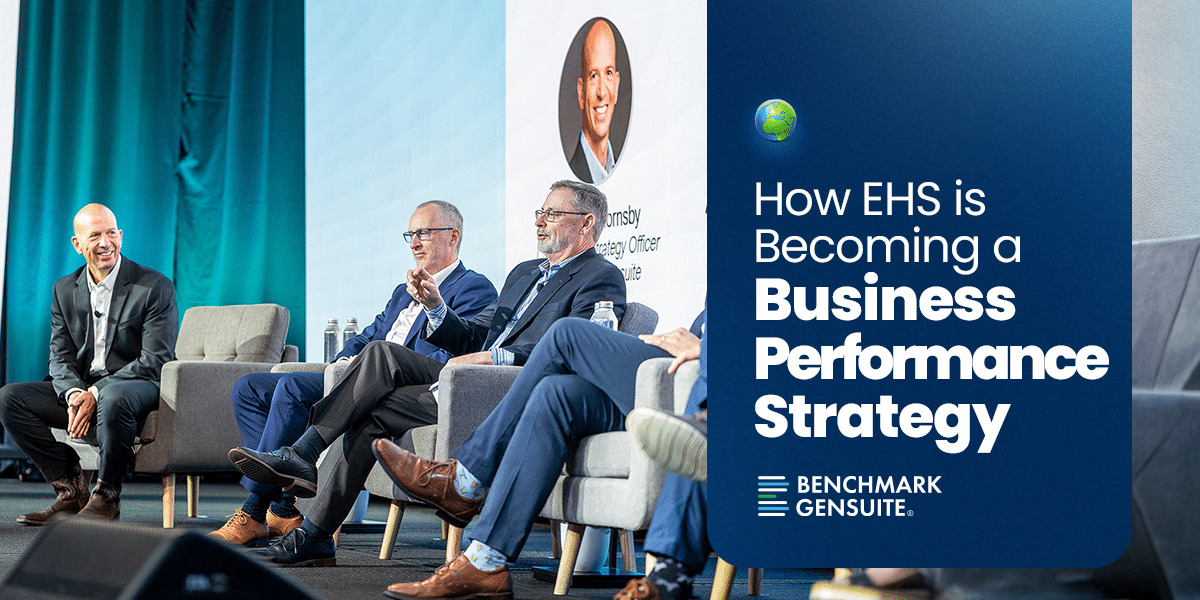
That broader perspective shaped the Industry Leaders Panel at Benchmark Gensuite’s Customer Conference IMPACT 2026, where leaders from Applied Materials, Colgate-Palmolive, E. & J. Gallo Winery, Kenco Group, Sherwin-Williams, and Verdantix explored how changing business priorities are influencing leadership, technology investments, and the way organizations measure the impact of their EHS programs.
Safety and Business Performance Are No Longer Competing Priorities
One of the strongest themes from the discussion was the relationship between effective risk management and business outcomes. As organizations navigate growth, operational complexity, and evolving business priorities, many EHS leaders are now expected to demonstrate how their work contributes to broader organizational objectives.
Throughout the conversation, panelists described how reducing risk also helps companies minimize disruptions, maintain production, and improve operational continuity. In other words, protecting people and contributing to business performance are not separate objectives; they often reinforce one another.
Allison Montgomery, Vice President of EHS at Applied Materials, explained how those conversations are changing within her organization:
“We talk about how do we reduce risk, and what would that lead to? It leads to, of course, a safer environment for our employees, but it also leads to less downtime for our production side of the house… You still have to talk about your business and how you’re supporting your business to be productive.”
Her perspective reflects a broader shift in how many businesses evaluate the impact of EHS programs. Success can also be reflected in the ability to keep operations running, reduce unnecessary disruption, and support the business as it grows.
Effective EHS programs help organizations build the resilience needed to operate safely, consistently, and efficiently.
Growth Has Changed What EHS Teams Need
If organizations rely more heavily on EHS to contribute to operational results, they also need to equip EHS teams to meet those expectations.
One of the recurring themes throughout the discussion was scale. As companies expand, EHS leaders must maintain strong performance across more facilities, employees, and increasingly complex operations. This shifts the focus from simply managing risk to finding ways to apply expertise more consistently across the organization.
Marty Stern, Vice President of Global EHS at Colgate-Palmolive, described how limited visibility can make it difficult for organizations to identify operational risks across complex environments:
“Things that happen day in, day out that you have no visibility on until you start looking and using technology solutions.”
Rather than relying solely on additional headcount, panelists emphasized improving visibility across operations, connecting information across systems, and creating consistent processes that allow expertise to scale more effectively. With expectations expanding, EHS leaders need ways to extend the impact of experienced teams—not simply grow them.
Chris Savage, Vice President at E. & J. Gallo Winery, echoed this point, observing that many organizations are “data rich and information poor.” As operations grow, the challenge is turning that information into insights that help the business make better decisions.
Leadership and Employee Engagement in Modern EHS
Technology alone isn’t enough. As companies modernize EHS, leaders are also adapting the way they engage and communicate with a changing workforce. Panelists noted that today’s employees bring different expectations around communication, transparency, and participation, requiring organizations to move beyond one-way messaging and provide greater context around safety initiatives.
John Barlew, Vice President of Safety at Kenco Group, described how his company has adapted its approach by placing greater emphasis on communication and storytelling:
“They want to be part of something greater than themselves, and one of those things is working for a safe organization… With safety, there is a greater sense of shared purpose and value.”
Building trust is an important part of that approach. According to Benchmark Gensuite’s 2026 EHS Report, 45% of respondents estimate that up to a quarter of workplace incidents go unreported. Creating an environment where employees feel comfortable speaking up helps improve visibility into risks and strengthen safety culture.
Marty Stern, Vice President, Global EHS at Colgate-Palmolive, shared that his team found strong correlations between employee engagement and both operational and EHS metrics. Those findings reinforce an important takeaway from the discussion: resilient operations depend not only on effective processes and technology, but also on leaders who foster trust, engagement, and open communication across the workforce.
Using AI to Extend EHS Expertise
After discussing performance, scale, and leadership, one question naturally follows: How do companies meet these growing expectations without placing additional demands on already stretched teams?
Throughout the panel, AI was consistently positioned not as a replacement for professional judgment, but as a way to help experienced teams work more efficiently and focus on higher-value activities.
Donavan Hornsby, Chief Market Strategy Officer at Benchmark Gensuite, described AI as a partner that helps professionals access information and make better-informed decisions, not a substitute for human expertise. Technology is most valuable when it reduces administrative work and makes knowledge more accessible across the organization.
Allison Montgomery shared a practical example of how her team is evaluating AI. Rather than asking where technology can replace people, they’re asking which routine, administrative tasks can be automated so experienced EHS professionals can spend more time coaching employees, solving complex problems, and supporting the business.
The conversation also reinforced that technology is only as effective as the expertise behind it. Randy Brillhart, from Sherwin-Williams, emphasized that AI still depends on subject matter experts to provide the knowledge and context needed to produce meaningful results.
Together, these perspectives point to a broader conclusion: technology is most effective when it complements human expertise. AI can help organizations reduce administrative work, surface relevant information, and improve consistency, but its value ultimately depends on the experience, judgment, and context that skilled professionals bring to every decision.
The Bigger Shift: What’s Next for EHS Leaders
Taken together, the discussions at IMPACT 2026 point to a broader shift in the role of EHS. Success is no longer measured solely by what EHS prevents, but also by what it enables.
The future of EHS won’t be defined by a single technology, regulation, or performance metric. It will be shaped by how effectively organizations combine experienced leadership, engaged employees, connected information, and practical innovation to build more resilient operations.
Compliance remains the foundation of every mature EHS program. But as businesses continue to grow and evolve, the conversation is increasingly focused on something broader: how EHS helps businesses operate more consistently, adapt more confidently, and create lasting value for both their people and their operations.