EHS and operational leaders work across large volumes of information every day. Audits, incidents, corrective actions, sustainability metrics, and compliance workflows all contribute valuable operational context, but understanding how those signals connect across sites often requires significant time and coordination.
For many teams, analysis becomes an additional operational burden layered on top of existing responsibilities. Reports need to be reviewed, findings aligned, and trends communicated before priorities become clear enough to support action. Smaller EHS teams may lack dedicated analytical resources, while larger organizations often struggle to maintain consistent visibility across programs and locations.
Over time, delays in interpreting operational data can slow prioritization, reduce responsiveness, and make it harder for leaders to focus attention where it matters most.
Why Operational Data Often Slows Decision-Making
Traditional reporting tools are effective at displaying information, but much of the interpretation still depends on manual analysis. Teams are responsible for identifying recurring issues, comparing performance across sites, and determining which findings require immediate attention.
That process can vary significantly across users and teams. Similar datasets may lead to different conclusions, while recurring risks or compliance gaps can remain buried inside reports and dashboards until someone manually connects the dots.
As operational data expands across systems and workflows, building a complete picture becomes increasingly difficult. Important trends may surface later than expected, reducing the speed and confidence behind operational decisions.
How AI Helps Teams Surface Operational Insights Faster
Operational data becomes more valuable when teams can quickly understand where attention is needed and why. AI helps accelerate that process by analyzing large volumes of information across reports, dashboards, workflows, and datasets in real time.
As new information enters the system, AI can identify recurring issues, performance gaps, overdue actions, anomalies, and emerging operational trends that may otherwise require hours of manual review to uncover. Insights are then organized into concise summaries that help teams evaluate priorities faster and with greater consistency.
This also improves broader operational visibility. Instead of relying on separate reviews within individual teams, leaders gain clearer visibility into operational performance through insights that are continuously surfaced within the workflows they already use.
By reducing the effort required to interpret data manually, teams can spend less time preparing reports and more time investigating issues, coordinating responses, and driving improvement initiatives forward.
How Genny AI Insights Helper Works
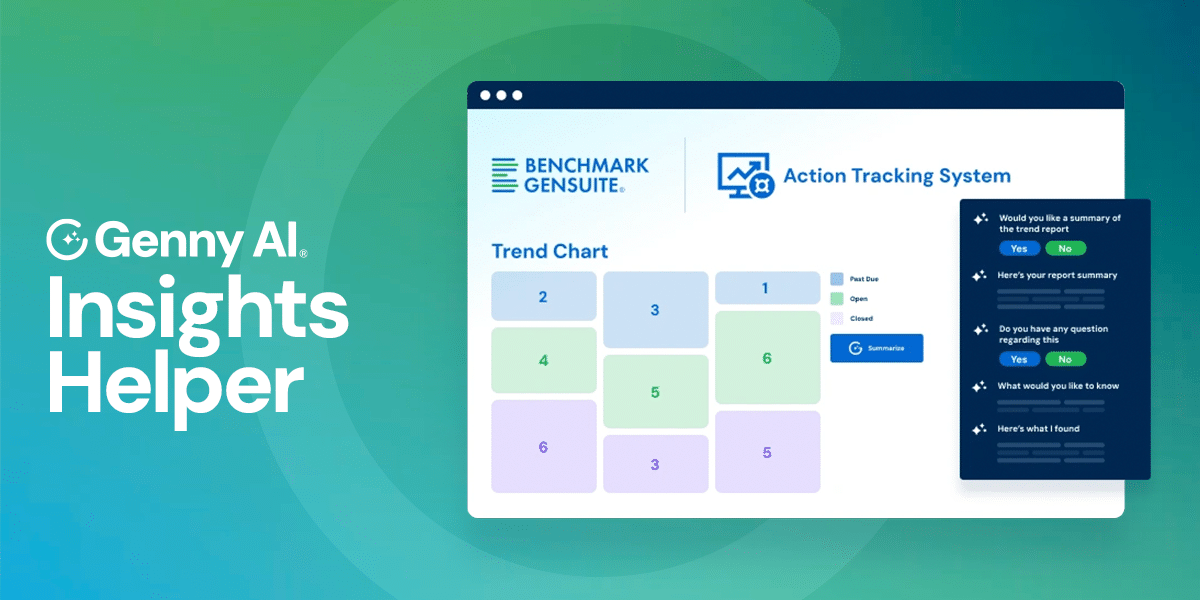
The Genny AI Insights Helper is embedded directly throughout the Benchmark Gensuite platform and delivers contextual insights wherever users interact with operational data. It follows a structured process designed to help teams surface and understand important findings faster.
Analyze operational data across workflows
The Insights Helper reviews reports, dashboards, forms, and datasets across supported Benchmark Gensuite applications, including Incident Management, Audit Assistant, Sustainability Reporting, Action Tracking System, Contractor Manager, and more.
Identify trends, anomalies, and operational gaps
AI evaluates operational information to detect recurring issues, performance outliers, overdue actions, compliance concerns, and emerging trends across sites and programs.
Generate concise, actionable summaries
Key findings are organized into formatted summaries that help users quickly understand where attention may be needed and what operational patterns are developing.
Prioritize focus areas across teams
Insights are surfaced based on relevance and operational impact, helping leaders focus on critical items, recurring findings, and higher-priority concerns without manually sorting through reports.
Deliver insights directly within existing workflows
Summaries and insights appear within dashboards, homepages, reports, and supported applications, allowing teams to access operational intelligence without exporting data or switching tools.
Changing Day-to-Day Decision-Making for EHS Leaders
The ability to quickly interpret operational information has a direct impact on how teams respond to risk and performance issues. For many organizations, analysis still requires spreadsheet preparation, cross-system reviews, and significant effort to consolidate findings.
The Genny AI Insights Helper helps reduce that effort by surfacing relevant insights automatically within existing workflows. Instead of spending hours consolidating reports or searching for patterns, leaders receive concise summaries that help prioritize actions and identify areas requiring attention.
This creates measurable impact across EHS and operational programs. Organizations using Genny AI capabilities have reported reductions of up to 50% in analysis and data cleansing time, while saving more than 16,000 hours across AI-supported workflows. Faster access to operational insights also helps teams improve response times, strengthen visibility across sites, and support more confident decision-making.
Built to support EHS, sustainability, quality, and operational leaders, the Insights Helper improves how organizations interpret and act on data while keeping judgment, prioritization, and decision-making with the people responsible for managing risk and performance.
See the Genny AI Insights Helper in Action
Explore how AI-powered operational insights help teams identify trends faster, reduce analysis time, and focus attention on the issues that matter most across EHS, sustainability, and operational workflows.