Recordable rates such as TRIR and DART have helped safety teams track progress for decades, and they have trended steadily downward. That foundation makes room for a new focus: seeing where the most serious harm could occur.
In the United States, 5,070 workers died from work injuries in 2024, after 5,283 in 2023, while the private-industry recordable rate edged down to 2.3 cases per 100 full-time workers. For programs that already track recordables well, seeing serious risk earlier is the natural next step.
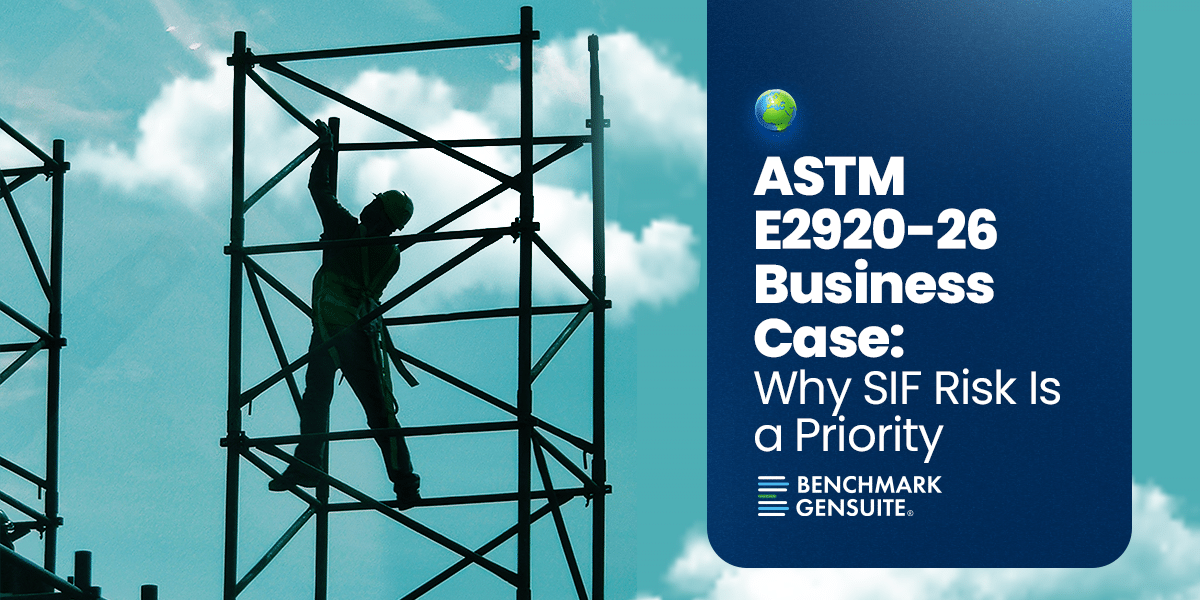
This is why safety leaders are making ASTM E2920-26 a strategic priority. Published in January 2026 and endorsed by the National Safety Council (NSC), the updated standard adds a consistent, benchmarkable way to see serious injury and fatality (SIF) risk before someone is hurt.
That focus was at the heart of the webinar Beyond Recordables: The New ASTM Standard for Identifying SIF Risk Before an Incident, featuring Laura Fiume, Associate VP, Strategic Solutions & Growth at Benchmark Gensuite, and Chris Louis, Senior Leader at the National Safety Council (NSC). This blog draws on their conversation to look at why leaders are prioritizing ASTM E2920-26, the business case behind it, and how organizations are building it into the incident management processes they already run.
To learn more about the new standard, see our ASTM E2920-26 overview.
Three Ideas That Change How Leaders See Risk
During this conversation, Chris Louis highlighted the ideas that shift how safety leaders think about risk. ASTM E2920 2026 revision expands the severity classification from the two levels in the previous version to four. Levels 1 and 2 together cover the serious cases previously captured at Level 1, so organizations can still compare results with earlier years. Three ideas stood out.- Potential matters as much as outcome. A potential SIF (pSIF) is a near miss or hazardous event that could have resulted in a serious injury or fatality. Chris illustrated it with a suspended load: when a barrier keeps people out of the way, a drop is a controlled near miss. When it falls and no one is underneath only by chance, it is an uncontrolled one.
- “Controlled” is something you can verify. A controlled event means a safeguard was in place, worked as intended, and can be audited. An uncontrolled event means no safeguard existed or it failed to perform. Tracking the split shows how well critical risks are being managed.
- Residual risk deserves a place in the conversation. Chris noted that the risk remaining after controls are in place is worth assessing deliberately. For SIF risks, that is why multiple layers of safeguards between the worker and the hazard matter.
What Severity-Based Measurement Adds to Recordable Rates
TRIR remains the foundation of most safety programs. Since OSHA began tracking recordable injuries in the early 1970s, it has given organizations a common way to measure how often injuries occur, and the steady decline in recordable rates reflects real progress. Frequency is its strength, and also where its insight ends: a recordable rate counts cases, not how severe the worst of them could be. That distinction matters more than it once did. Around 2009, the preventable death rate began to rise even as recordable rates kept falling, and the gap between the two has widened since. Lower recordable rates alone do not prevent serious injuries and fatalities, so the next level of prevention depends on a complementary measure built around severity and potential. That is the role ASTM E2920-26 is designed to play. Many safety professionals have long sensed this difference and looked for a clear way to articulate it to senior leadership. A framework built on severity and potential gives that conversation a shared structure. Chris summed up the idea simply: “the things that hurt people differ from the things that kill people. Most safety teams work with limited budgets and time, so knowing where serious harm is most likely helps focus both”. ASTM E2920-26 adds three things:- It classifies by the injury itself. ASTM severity is based on the type of injury, which keeps classification consistent across sites and medical practices.
- It makes severity benchmarkable. Level 1 and Level 2 rates are calculated per 1,000,000 hours worked, compared with 200,000 for TRIR, and can be compared across organizations and years.
- It brings near misses into view. Tracking pSIFs and whether safeguards held (controlled vs. uncontrolled) shows how well critical risks are being managed, alongside how often people are injured.
The Business Case for ASTM E2920-26
Across the webinar, five practical outcomes made up the business case.- Resources go where serious risk is highest. Severity-based classification helps teams direct limited investigation, control, and verification effort toward the exposures most likely to cause life-altering harm.
- One shared definition. Many organizations have written their own criteria for serious incidents. A common framework supports consistent classification and meaningful benchmarking across sites, divisions, and peers.
- Leadership conversations change. Perrigo, which aligned its incident classification with the standard, shared with Laura Fiume that frontline discussions grew to include questions like “how severe could this have been, and what exposure must we address?”
- Decisions are documented and repeatable. Structured work-relatedness evaluation and the controlled/uncontrolled distinction create a record of how each classification was reached and whether safeguards were verified.
- It connects to a wider SIF prevention body of work. NSC has contributed to three additional standards covering environmental, fire, and business interruption SIF events; SIF risk identification and reduction; and leader and worker engagement. Organizations that adopt E2920-26 are building on a foundation that continues to expand.
How to Integrate ASTM E2920-26 Into Your Existing Incident Management Process
Organizations can adopt the standard within the reporting process they already have. Most already collect the core information, such as injury type, body part, treatment, and circumstances. ASTM classification can sit on top of that process, alongside TRIR, DART, and OSHA recordability. Laura Fiume framed the work as four steps, with ASTM becoming part of how the organization already manages and learns from incidents:- Capture severity and potential in the existing workflow. Add the ASTM fields to the injury and illness form people already use. Keep the first report of a concern short, and let it escalate into a full case so frontline reporting stays easy.
- Classify consistently. Map the injury and illness types you already record to Level 1 and Level 2 criteria so classification stays consistent regardless of who enters the case. Some drop-down values may need adjusting to match the standard’s wording. A laceration, for example, requires a size qualifier.
- Evaluate work-relatedness with a repeatable test. The standard applies three tests: connection, contribution, and context. Guided yes/no questions that record the reasoning keep decisions consistent across sites and easy to revisit later.
- Analyze and act. Calculate Level 1 and Level 2 rates next to your recordable rates. Trend them by site, division, injury type, and time period, then track pSIFs and the share of controlled versus uncontrolled events through corrective action.
Setting Leaders Up for a Strong Start
Both speakers returned to one theme: set expectations early. Four points came up in the discussion.- pSIF reporting often grows at first. Chris Louis noted that numbers often climb during the first couple of years after pSIF tracking begins, then level off. That growth reflects greater visibility into events that were already occurring. The more useful measures become follow-up quality and the share of events that were controlled.
- Early benchmarking is often year over year. Subscribers who re-classified history tend to look first at internal trends by division or shift. For external comparison, NSC runs a SIF community that organizations can join to benchmark ASTM data, and membership is not required.
- ASTM classification is separate from compensability. The work-relatedness test is intended for internal use to focus effort. It has no bearing on workers’ compensation decisions, just as an OSHA recordable case may or may not be compensable.
- Your SIF risk model should fit your culture. Organizations frame SIF risk in different ways: by task, such as lockout/tagout and confined space entry; by energy source; or by behavior and concept. NSC’s guidance is that no single approach is right, so choose the one your people will recognize and use.
How Benchmark Gensuite Supports ASTM E2920-26
In a live demonstration during the webinar, Laura Fiume showed the approach Benchmark Gensuite built with an ASTM workgroup of subscribers and in collaboration with NSC. ASTM E2920-26 capabilities sit inside the existing injury and illness case workflow of Incident Management, so teams keep reporting and calculating recordables as they do today.- ASTM fields appear in the same case form users already complete.
- Injury and illness types already captured are mapped to Level 1 and Level 2 severity.
- Guided questions walk users through the work-relatedness tests and document the reasoning.
- Packaged reports and dashboards calculate ASTM rates alongside OSHA rates and filter by site, division, and time period.
Seeing Serious Risk Earlier
ASTM E2920-26 builds on the metrics safety leaders already trust. It adds a shared language for severity and potential, so serious risk becomes easier to see, compare, and act on before an incident occurs. For organizations already running mature incident management programs, integration is largely a matter of extending what is in place. To hear Chris Louis explain the thinking behind the standard, see Laura Fiume walk through classification live, and follow the full Q&A, watch the on-demand webinar, Beyond Recordables: The New ASTM Standard for Identifying SIF Risk Before an Incident.FAQ's
How does ASTM E2920-26 work alongside OSHA recordkeeping and TRIR?
Both speakers described ASTM classification as a layer that sits on top of TRIR, DART, and OSHA recordability. The standard is not a substitute for legally required recordkeeping, so the two views run side by side.
How does ASTM classification relate to workers' compensation?
The two are independent. Chris explained that the work-relatedness evaluation is intended for internal use, to focus effort on more severe incidents within the employer’s control, and it has no relationship to compensability.
Should we measure against an industry rate or our own trend?
Subscribers in Benchmark Gensuite’s ASTM workgroup asked mainly for year-over-year views by division and shift, after re-classifying historical records. For external comparison, Chris pointed to NSC’s SIF community, which organizations can join without NSC membership to benchmark ASTM data.
Can ASTM data be captured at the concern reporting stage?
Technically, yes. Laura recommended keeping concern reports short so reporting stays easy, and capturing ASTM information in the injury and illness case that a concern report escalates into.
How do existing injury and illness categories map to the standard?
The classification logic builds on values organizations already capture, and some wording may be adjusted to match the standard. A laceration, for example, uses a size qualifier that may need to be added to current drop-downs.