Keeping People in the Loop: How the Good Catch Program Turns Safety Data Into Action
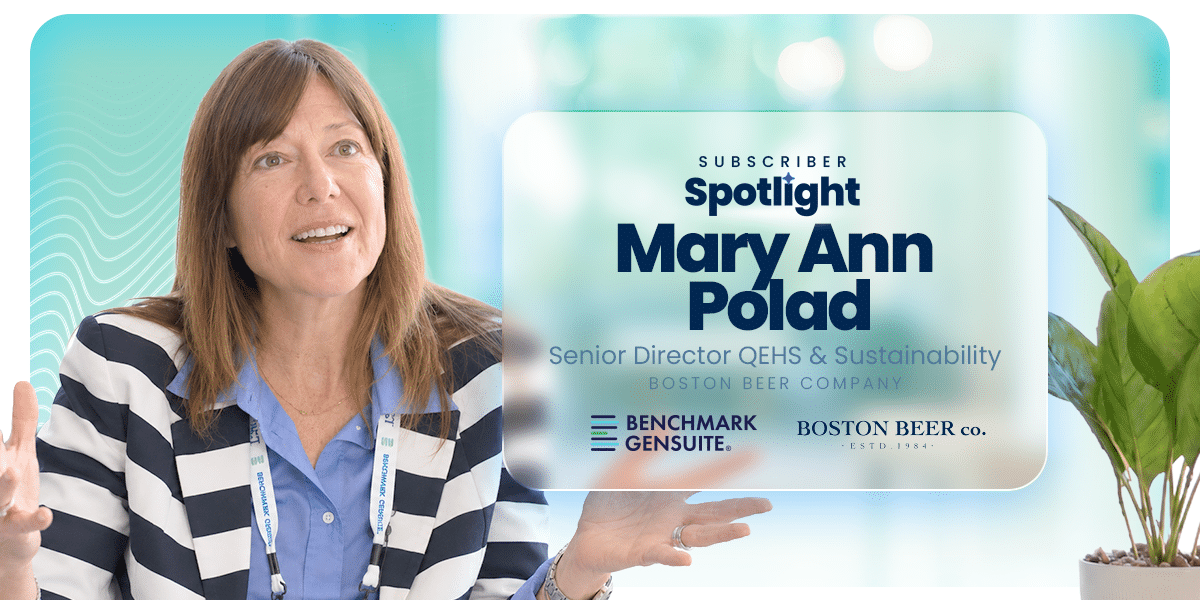
For Mary Ann Polad, an effective safety reporting program needs to fit into the way people already work. At The Boston Beer Company, this principle shapes its Good Catch program, the company’s name for its digitized concern-reporting process. Coworkers can report potential safety issues within their existing work environment, while supervisors are expected to respond and provide an update within five days.
During its seven-year partnership with Benchmark Gensuite, Boston Beer has used data from its Good Catch program to support supervisor engagement and connect frontline reporting with visible follow-up. The program demonstrates how accessible data, adaptable technology, and consistent partnership can help make safety part of everyday operations.
Key Takeaways from Mary Ann Polad on Safety Reporting and Engagement
- Make reporting easy and accessible: Coworkers are more likely to participate when they can submit information within their existing work environment.
- Set clear expectations for follow-up: Response timelines and measurable supervisor expectations help keep reported concerns moving toward resolution.
- Deliver information where people work: Understanding when, where, and how supervisors use information makes safety data more practical.
- Adapt the system as the program evolves: Flexible workflows and reporting allow organizations to shape the system around their people and processes.
- Maintain the relationship beyond implementation: Consistent support helps teams continue improving how they use their data over time.
How has an EHS management system helped Boston Beer advance its safety goals?
Mary Ann: I’m honestly really proud of the work we’ve done with Benchmark and what we’ve been able to introduce into the organization in terms of solid data.
I said to someone recently that the work we’ve done with Benchmark Gensuite over the last seven years will be a very big part of my legacy at The Boston Beer Company.
I’m really proud of the way we’ve used data to engage supervisors. We’ve used the system to digitize things like what you call Concern Reporting and we call Good Catch. We made it easy for people to do that.
How is your EHS team using AI, and how have coworkers responded to it?
Mary Ann: Interestingly enough, the EHS team has been using AI for a year, 18 months now, both in the ergonomics space and now more aggressively in the data space.
In fact, the work we’ve done has been showcased internally as a really good opportunity that benefits coworkers. That’s been pretty cool.
I think it’s a good use case because coworkers see the immediate and direct benefit, not just as it relates to how they do their work for Boston Beer, but in their personal lives. Protecting yourself at work is inherent to protecting what your home life looks like.
They saw the benefit, and I think that spurs engagement and eliminates fear about what AI can do. All the protections were in place. It felt like a safe place for folks, so it was a good use case for us to highlight.
How has the Good Catch program changed the way coworkers report concerns and supervisors respond?
Mary Ann: Every year, we do an engagement survey for all of our coworkers. One of the questions for the supply chain is, “How satisfied are you that your supervisor helps you solve problems or resolves issues?”
That score has increased precipitously over the last three years, and I attribute that to our engagement with our Good Catch program.
We did a lot of work to set metrics, be clear about expectations for supervisors and coworkers, and measure against that. But there’s no way we could have had that type of influence and impact without the system, without using Benchmark Gensuite to help us manage the information and deliver it to coworkers in an easy way. I’m really proud of that.
What have you learned about making safety information useful to supervisors?
Mary Ann: It has to be easy, it has to be simple, and it has to be accessible.
We spent a lot of time talking with supervisors to understand how they get their information and in what context. What are they looking at before they start their shift at the start of the day? What are they expected to report to their manager?
We took that to heart, and we delivered the information where they are. We didn’t do something different or unique. For example, early on, we automated email communications that supervisors received every morning. They got the communication at 5:00 a.m. It came to them, it was on their phone, and it was right there.
How did you make the Good Catch program accessible to coworkers in the manufacturing environment?
Mary Ann: For coworkers, we put the system on the floor. We didn’t do anything extra or add extra equipment. There are iPads and phones and all that kind of stuff, but we put the system in the manufacturing environment.
We use a manufacturing execution system to manage all of our production. A filler operator could be standing there watching can lids go in and monitoring where they are with can lids. At the same time, they’ve got a screen open with a Good Catch Share It Fast form. It’s right there.
Why does adaptability matter in an EHS management system?
Mary Ann: We’ve not had any constraints with using or modifying the Benchmark Gensuite system to deliver that simply, easily, and accessibly.
We’ve used the way we configured the Benchmark Gensuite system as an example of how we can do it better internally.
Where the rubber meets the road is the ability of a system to flex and adapt to the needs of its users.
We built in a metric around response rates. Supervisors have to answer a Good Catch within five days and put some kind of comment in there. We measure against that, and we pull that data out of Benchmark. I don’t know if anybody else is doing that, but that was really important.
That’s been the crux of it: being able to flex and adapt the system to meet our needs.
What has stood out about your relationship with the Benchmark Gensuite team over the last seven years?
Mary Ann: There’s this whole slew of people. I think it’s a testament to the care that the organization has for its customer.
Our decision to go with Benchmark Gensuite at the time was extraordinarily well-vetted. We went to Gartner, did all that research into who the top contenders were, and then weeded it all down.
In the end, we went with Benchmark because of the real commitment we saw to our mutual success. Here we are seven years later. That commitment to our mutual success is as real today as it was seven years ago.
How do you want to use safety data to support Boston Beer’s zero-harm goals?
Mary Ann: What I care about over the next four to five years is getting to zero injuries.
How that translates into where we are over the next six months to three years is a focus on zero harm. How we get to zero harm is by eliminating risk. How we get to eliminating risk is understanding where those risks are, and that’s where Benchmark comes in.
I want generative AI to be the best it can be to help me identify risk and package that assessment in a way that is influential with our executive team and our operating leaders.
We’ll probably look to take advantage of significant incident reporting, shift how we think about precursor events, and start to shift the thinking and mindset around risk elimination.
The data is there. What I’m looking for is insight.
Final Reflections: Designing Safety Reporting Around People
Boston Beer’s Good Catch program connects frontline reporting, supervisor response expectations, and accessible safety data in one process. Coworkers can submit information within their working environment, while supervisors receive information through channels that fit their daily routines.
For Mary Ann Polad, the ability to adapt the system to those needs has been central to the program. Just as important is a partnership that has remained close and responsive as Boston Beer’s use of the platform has evolved.
Her experience reflects a practical lesson for safety reporting: the data needs to reach people in a form they can use, and the system needs to adapt to the work happening around it. That foundation is now helping Boston Beer look beyond collecting Good Catches toward identifying risk and generating the insights needed to support its zero-harm goals.