For decades, enterprise technology has evolved alongside EHS, Sustainability, and Operational Risk programs. As organizations expanded globally, managed increasingly complex operations, and adopted digital workflows, software evolved to help EHS leaders standardize processes, improve visibility, and make better-informed decisions.
Today, AI is accelerating that evolution. According to NAEM’s The State of Artificial Intelligence in EHS and Sustainability (2026), 94% of surveyed organizations now use AI in some capacity, up from just 5% in 2019. As AI becomes part of everyday work, the conversation is shifting beyond adoption toward a more fundamental question: How should enterprise technology evolve to help practitioners make better decisions?
That question shaped many of the discussions at IMPACT 2026. Rather than focusing on AI as another feature, speakers described a broader shift toward AI-native experiences—where intelligence is embedded throughout enterprise EHS software to reduce friction, connect information, and allow experienced professionals to focus their expertise where it creates the greatest impact.
A New Set of Expectations for Enterprise Technology
Organizations continue to grow, creating increasingly complex operations. Today, success depends not only on collecting information, but on turning it into timely, actionable decisions. Beyond digitizing processes or centralizing information, EHS platforms are expected to connect people, systems, and operational knowledge in ways that simplify work and enable faster action.
That broader evolution framed Donavan Hornsby’s opening presentation at IMPACT 2026. He described AI not as another standalone capability, but as part of a connected enterprise where interoperability, contextual information, and intuitive experiences work together to support better decisions.
“It takes connected enterprise, connected workers to make this happen.”
With this objective in mind, Benchmark Gensuite’s platform priorities for 2026 were outlined by three main areas of investment: next-generation user experiences, enhanced business intelligence, and expanded system self-configurability. Together, these priorities reflect a vision for enterprise technology that is more intuitive, connected, and better equipped to support practitioners.
Donavan emphasized that this direction didn’t begin with AI. It reflects nearly three decades of collaboration between Benchmark Gensuite and the subscribers who have continuously shaped the platform.
“The result of a couple of decades of best practice development… organically developed with all of you over the years.”
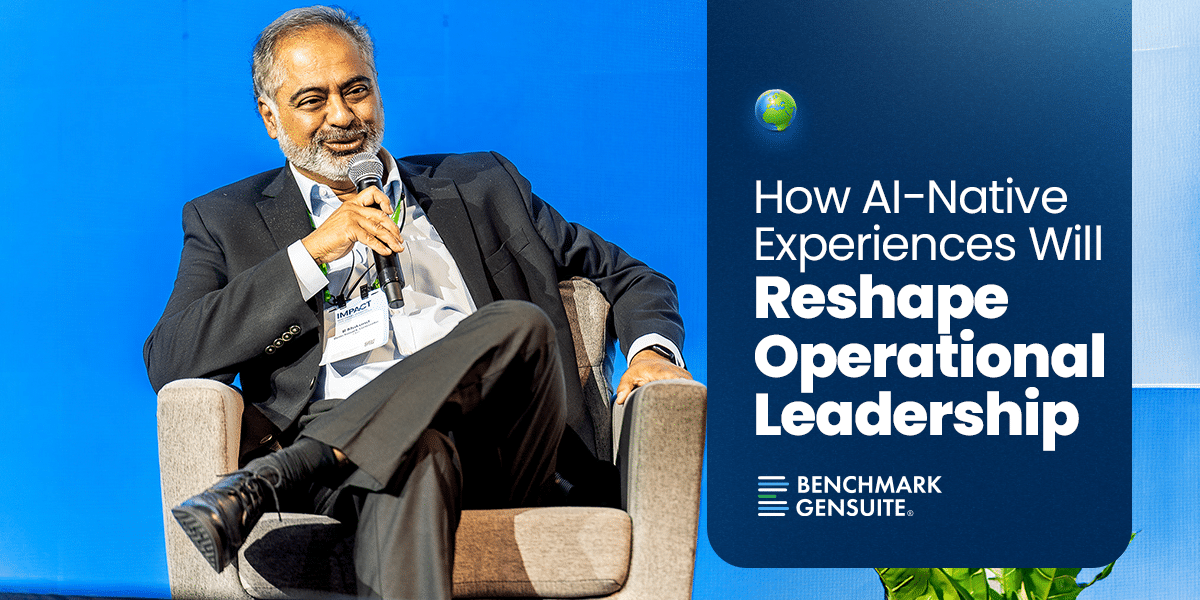
That perspective set the stage for one of CEO R. Mukund’s central ideas: as the work of practitioners continues to evolve, enterprise software must evolve with it by changing how people interact with technology.
From Enterprise Software to AI-Native Experiences
For nearly three decades, Benchmark Gensuite has approached technology to enable organizations to manage multi-step workflows. As EHS, Sustainability, and Operational Risk programs have grown more complex, so has the platform—expanding from digital recordkeeping and connected workflows to intelligent capabilities that help organizations act on information more effectively.
That philosophy remained at the center of Mukund’s keynote at IMPACT 2026. Reflecting on the company’s journey, he emphasized that technology has always evolved to support Benchmark Gensuite’s broader mission of helping EHS leaders solve complex operational challenges.
The emergence of AI represents the next chapter in that evolution. Rather than adding AI as another feature, Mukund described AI-native experiences where intelligence is embedded throughout the platform to better understand context and inform decision-making.
This represents a fundamental shift in how EHS professionals interact with enterprise technology. Instead of adapting their work to software, software increasingly adapts to the way people work.
Technology Designed Around the Way Practitioners Work
If enterprise technology is becoming more intuitive and connected, AI-native experiences are what make that vision possible. Intelligence is embedded into everyday workflows, helping organizations understand context, connect information, and coordinate actions without disrupting the way EHS professionals already work.
Benchmark Gensuite illustrated this vision through Ultra, an orchestration layer that connects organizational knowledge, enterprise systems, and specialized AI capabilities to help users move naturally from questions to action.
As Mukund explained, asking a language model to interpret large volumes of information often produces inconsistent results because it lacks the organizational knowledge needed to understand how work gets done.
“If you pass a bunch of content to an LLM and say, ‘Figure this out,’… most of the time it’s going to figure it out in some random way.”
AI-native experiences address that challenge by combining enterprise knowledge with operational context, helping practitioners navigate work based on business processes, organizational guidance, and user intent rather than isolated prompts.
Ultimately, the goal is to remove friction so leaders can spend less time navigating software and more time making informed decisions.
Turning AI-Native Vision into Everyday Work
The discussion became more practical during the conference’s leadership panel, where speakers explored how AI can strengthen decision-making while preserving the expertise that drives safe, compliant, and resilient operations.
For Allison Montgomery, Vice President of EHS at Applied Materials, part of the answer lies in making expertise more scalable. As organizations continue to grow, AI can help experienced teams extend their knowledge across more sites and operations without increasing EHS headcount at the same pace—making guidance, best practices, and institutional knowledge more accessible across the organization.
The panel also underscored that successful AI adoption depends as much on the user experience as it does on the technology itself. John Barlew, Vice President of Safety at Kenco Group, noted that a new generation of employees brings different expectations for workplace technology. Enterprise platforms are expected to feel as intuitive as the digital experiences people use every day, helping professionals move naturally from questions to action rather than requiring them to navigate multiple workflows.
Equally important is trust. Organizations aren’t simply looking for faster answers—they need recommendations grounded in operational context, organizational knowledge, and transparent decision-making. As Chris Savage, from E. & J. Gallo Winery, summarized, many organizations today are “data rich and information poor,” highlighting that the challenge is no longer collecting information, but transforming it into actionable insight.
Together, these perspectives reinforce a broader shift taking place across enterprise technology. The future of AI isn’t defined by replacing human judgment or adding more standalone capabilities. It’s about creating experiences that make expertise more scalable, technology more intuitive, and operational decisions more informed.
Where Enterprise Technology Goes From Here
Every major shift in enterprise technology has been driven by the changing needs of the people using it. AI-native experiences represent the next stage of that evolution—not because organizations need more AI, but because they need technology that understands context, scales expertise, and allows users to spend less time navigating systems.
That was the vision shared throughout IMPACT 2026. As EHS, Sustainability, and Operational Risk programs continue to evolve, the opportunity isn’t simply to introduce more AI. It’s to build enterprise technology that adapts to the way people work, helping organizations strengthen decision-making while extending the expertise of the people driving operational excellence every day.