Seeing Risk Earlier: How Wearable Data and Shared Innovation Strengthen Workplace Safety
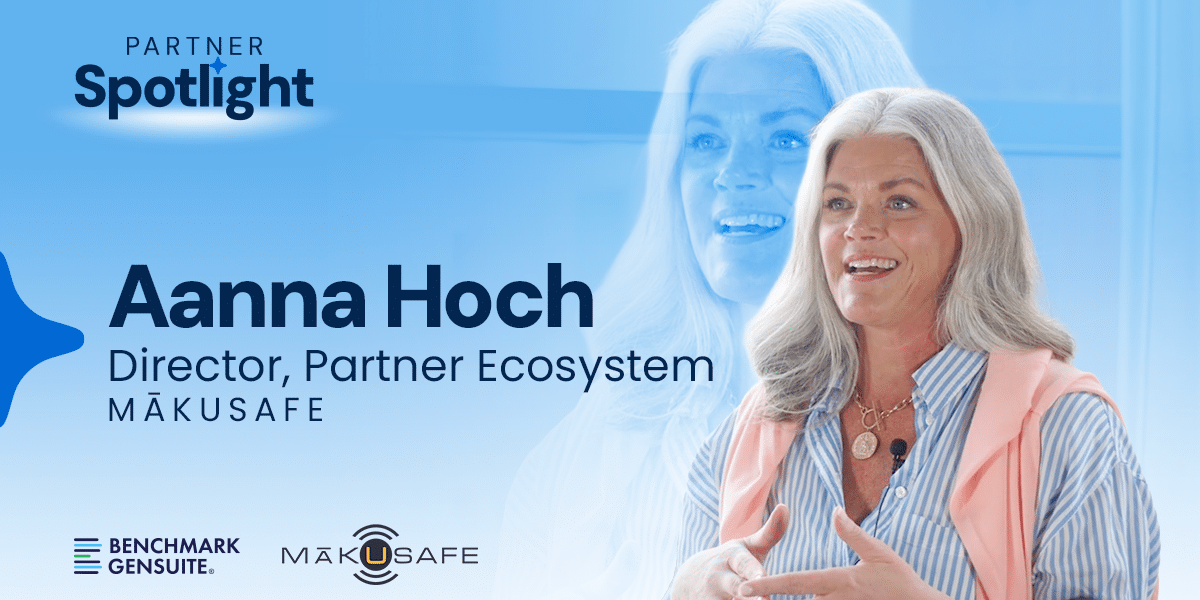
For Aanna Hoch, Director of Partner Ecosystem at MākuSafe, one of the most important shifts happening in workplace safety is how organizations are learning to act before incidents occur. As more companies look for ways to strengthen prevention, wearable technology and real-time data are helping safety teams uncover risks that traditional observations often miss, especially those tied to repetitive motion, physical strain, and day-to-day work exposure.
Through MākuSafe’s work with industrial organizations, Aanna has seen how leading indicators can change the way decisions are made by helping companies identify unseen hazards earlier and provide clearer insight into what frontline workers experience every day. This is also one of the reasons their partnership with Benchmark Gensuite has developed so naturally: both organizations are focused on helping safety teams act earlier, make better operational decisions, and turn better data into decisions that protect workers.
Key Takeaways from Aanna Hoch for Proactive Safety Programs
- Leading indicators reveal what routine observation often misses: wearable technology helps organizations uncover unseen risks before they become injuries.
- Better data strengthens prevention: rich frontline insights give safety teams clearer visibility to act proactively and improve worker wellbeing.
- Partnership grows through shared priorities: stronger outcomes emerge when organizations and their partners focus on solving real operational challenges together.
- AI becomes more valuable with stronger inputs: meaningful recommendations depend on reliable exposure data that reflects what workers experience every day.
What changes have you seen in how organizations view wearable safety technology?
Aanna: Adoption of wearable technology has been interesting. It’s definitely been a journey. MākuSafe is nine years old, and we went to market about five years ago, so we’ve seen a steady increase in understanding the impact of wearable technology—the impact of the data we’re collecting and how it can affect decisions not only for the safety and well-being of employees, but also for the well-being of the organization.
Before, there was concern about a “Big Brother” watching over frontline workers. Now we’re seeing this amazing amount of data that can actually protect frontline workers by providing insights that help make work better for employees. That evolution has really been fun to be part of.
What do the organizations that adopt technologies like MākuSafe tend to have in common?
Aanna: I think that’s actually what attracted us to Benchmark, because we saw many of the same characteristics in your subscribers that we see in some of our successful clients.
It’s people who want to be collaborative, who are innovative—and I know those are big buzzwords—but it truly is part of their cultural ethos. These are organizations where safety has a seat at the table, where it has the ear of the C-suite, and where safety is viewed not as a fractional part of the business or something thought about on the side, but as an integral part of how they operate.
Explore how shared innovation helps organizations strengthen safety performance
What led your company to begin exploring a relationship with an EHS software provider?
Aanna: We’ve been associated with Benchmark Gensuite for several years. We had been following what Benchmark Gensuite was doing and were really impressed.
About three years ago, we engaged because we thought, “Here’s an organization that’s responding to industry trends and seems to be very collaborative with other organizations.”
We’re a technology alliance member of Benchmark, and what we’ve really focused on is how to solve problems for your subscribers and for our clients. The genesis of that started with our “My Voice Feature.”
Part of our technology enables frontline workers to see something and report it immediately through our wearable. One of your subscribers saw that this was possible and said, “Hey, what if we use this data from the frontline worker to automatically populate concern reporting? How amazing would that be?” That’s really what started our collaboration, and we’ve continued growing from there.
Is there an example that best illustrates the kind of risk wearable technology can uncover?
Aanna: Early on, we ran a pilot with a company, and they called us and said, “We think your system is broken. This just absolutely can’t be. There are two women whose only job is to move these big gallons from point A to point B every day, just back and forth. But the data is showing that they have high physical motion, and that this one part of their job is very physical, and we just don’t see it.”
I said, “Well, let’s observe—we want to come and see what’s going on.” What we discovered was that moving the barrels from point A to point B was not the physical part of their job. But the beauty of wearable technology is that you start to see things you otherwise wouldn’t see.
What they were missing was that before moving the barrels, these women had to wrench open one part of the barrel every day, and there was really high physicality and a high risk of an MSD. Our solution picked up on this unseen task that these workers did every day, something they weren’t complaining about, but that eventually was going to cause an MSD or another injury.
By identifying that risk, they got a motorized wrench to open the barrel, fell off the caution list, and were able to do the job without that risk anymore. I love this story because it speaks to those unseen risks and how we can help uncover them.
Learn how wearable technology helps teams act before injuries occur
What role do you see AI playing as EHS technology continues to evolve?
Aanna: We can provide such rich, robust data, and that really helps AI work. We can tell the story of what’s happening to workers—their exposures and experiences—and the amount of rich data that can go into these systems for AI to analyze and create meaningful recommendations and trends that make an impact on worker wellbeing is really exciting for us.
That’s what it comes down to, right? Caring about your frontline workers and making sure they go home safely every day. It’s great to be part of that journey.
Discover how AI helps organizations identify trends and act earlier on workplace risks
What stood out early in your relationship with Benchmark Gensuite that made the partnership feel like the right fit?
Aanna: I think that’s really what led us to partner with Benchmark Gensuite. From our first interactions with people at an ASSP conference or NSC show, to our co-founder sitting down with top leadership, everybody has been so kind, but also generous with their time and collaborative in innovative discussions.
When it comes down to it, our partnership is really about solving problems. It’s not just about being added to a long list of great vendors you have an association with, but really about how partner solutions support what your subscribers are trying to do. How does it fill that void? How does it support the overall goal of making work better for so many people?
Being associated with Benchmark is great; everyone here is lovely. This is a fun community.
Final Reflections: Making Safety Decisions Earlier with Better Data
Aanna Hoch’s experience highlights how the future of workplace safety depends on seeing risks earlier and acting on better information. Technologies that capture real-time exposure data—from wearable devices to integrated EHS platforms—give organizations a clearer understanding of what workers experience every day. When those insights are paired with partners who share the same focus on solving real operational challenges, companies can move beyond reactive incident response and toward proactive prevention. Ultimately, stronger data and collaborative innovation help organizations protect their workforce while making smarter decisions about how work gets done.