
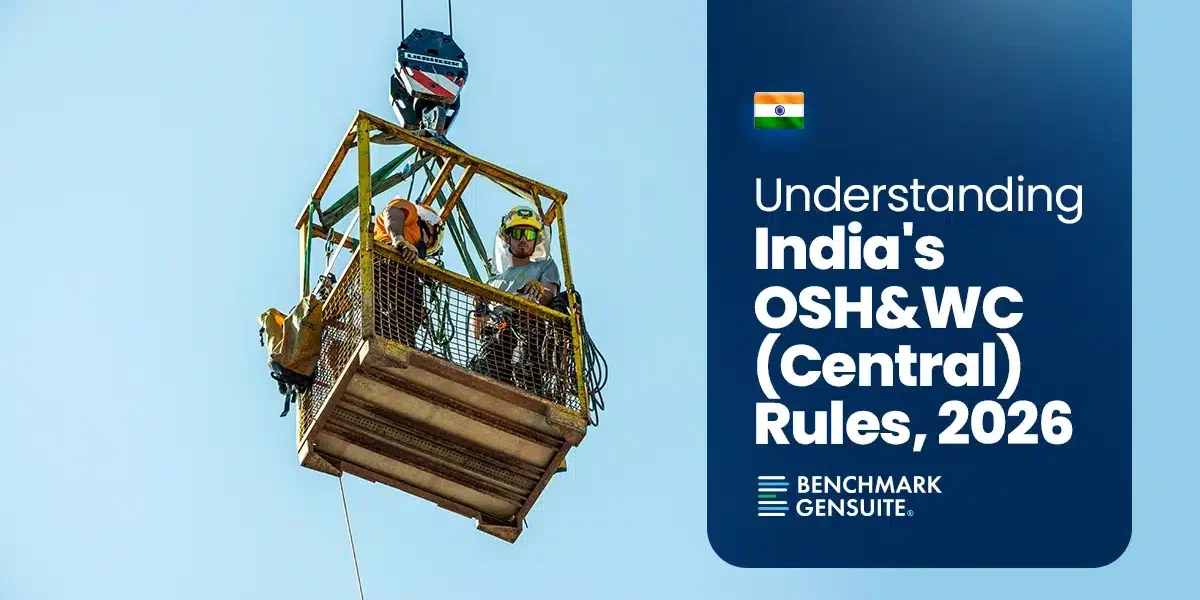
From Paper Law to Working Rulebook: India’s Safety Code Goes Live
On 8 May 2026, India’s Ministry of Labour and Employment notified the Occupational Safety, Health and Working Conditions (Central) Rules, 2026. The Rules now set out the forms, procedures, timelines, and operating requirements that organizations need to put into practice under the OSH Code. For EHS, Sustainability, Quality, and Operational Risk teams, the focus now shifts to integrating these requirements into established compliance and operational processes.
At a Glance
Now Applies to: Central Government Establishments
Establishments for which the Central Government is the appropriate Government under the OSH Code include railways and metro railways, mines, oilfields, major ports, air transport services, telecommunications, specified banking and insurance establishments, Central PSUs, and other establishments falling within the Central Government’s jurisdiction.
Applies Through State Rules to: State Government Establishments
Establishments for which the State Government is the appropriate Government, once the relevant State rules are notified.
Parent Law: Occupational Safety, Health and Working Conditions Code, 2020
The OSH Code has been in force since 21 November 2025 and consolidates 13 central labour laws, including the Factories Act and Mines Act.
What Has Changed Operationally
Establishment registration
Requirement: Online application through the Shram Suvidha Portal using Form I.
A complete application receives a registration certificate in Form III within 7 days. If the certificate is not issued within that period, the establishment is deemed registered and the certificate is auto-generated.
Appointment letters
Requirement: A prescribed appointment-letter format for every employee.
The format specifies particulars including employment type, designation, skill category, joining date, wages, social-security applicability, and duties.
Health surveillance
Requirement: Employer-funded annual medical examination for employees aged 40+ in specified work.
Applies to employees in dock work, mines, and building or other construction work. Mines have additional examination requirements under Rule 109.
Welfare facilities
Requirement: Welfare requirements tied to the type and size of establishment.
Requirements include canteens where 100 or more workers, including contract labour, are ordinarily employed, crèches where 50 or more employees are employed, and other facilities with their own sector and workforce thresholds.
Contract workforce
Requirement: Defined responsibilities for contractors and principal employers.
Contractors remain responsible for wage and other statutory obligations, while principal employers have specified responsibilities for welfare, minimum bonus, and settlement-related matters. A contractor can obtain a single licence covering multiple states or the whole of India.
Incident reporting
Requirement: Prescribed reporting for accidents and dangerous occurrences.
Dangerous occurrences must be reported in Form XI within 12 hours to the Inspector-cum-Facilitator and District Magistrate/Sub-Divisional Officer. Where an injury causes 48 hours or more of incapacity, the report is due within 12 hours after the 48-hour period is completed.
Working hours
Requirement: Normal working hours and overtime requirements are defined under the Code and Rules.
Normal working hours are capped at 8 hours a day and 48 hours a week. Overtime is payable at twice the regular rate, with overtime capped at 144 hours per quarter.
Record keeping
Requirement: Prescribed registers, records, notices, and returns must be maintained.
The Rules prescribe formats and permit registers to be maintained electronically or otherwise.
What This Means for Programs Already in Motion
Organizations that already have established compliance programs can build these requirements into the processes they use today. Existing obligation registers, health surveillance schedules, welfare records, contractor records, and incident workflows can be updated to reflect the new requirements and timelines.
For organizations managing requirements across multiple sites or regulatory frameworks, the new Rules also provide an opportunity to bring related obligations into a more connected compliance structure.
Three areas are worth a direct check this quarter, regardless of where a program stands today:
Incident reporting workflows
The Rules introduce defined reporting windows for dangerous occurrences and qualifying injuries. The escalation path from a frontline report to the required notification should be mapped, tested, and documented. See how Incident Management Software supports escalation workflows, notification timers, and evidence capture across sites.
Welfare facility records
The Rules specify workforce thresholds and requirements for facilities such as canteens and crèches. Existing facility records and site-level assessments should be checked against the applicable thresholds. See how Inspection Management Software maps facility checks to applicable thresholds and connects findings to corrective actions.
Contractor compliance data
The Rules place defined responsibilities on contractors and principal employers. Keeping contractor compliance information connected with internal compliance records can make those responsibilities easierto track across sites and workforces. See how Contractor Safety Management Software connects licence status, workforce data, welfare checks, and corrective actions in one view.
Operationalizing the Shift
For teams already managing EHS and regulatory requirements, the next step is integrating the new OSH requirements into established compliance processes, site workflows, and reporting structures. Benchmark Gensuite’s EHS Compliance Management and Operational Risk applications can help teams bring regulatory obligations, incident reporting, corrective actions, contractor requirements, and related compliance activities into a connected framework across sites and jurisdictions. For organizations building their OSH program around the new framework, our OSH Compliance Framework provides useful context on the broader compliance shift.
Ready to Map Your OSH Readiness?
The Central Rules are now in force. Use the 2026 OSH Readiness Assessment to evaluate where your current program stands across incident reporting, welfare facilities, contractor compliance, and recordkeeping and identify the specific areas that need attention before your next inspection. Explore the OSH Compliance Framework