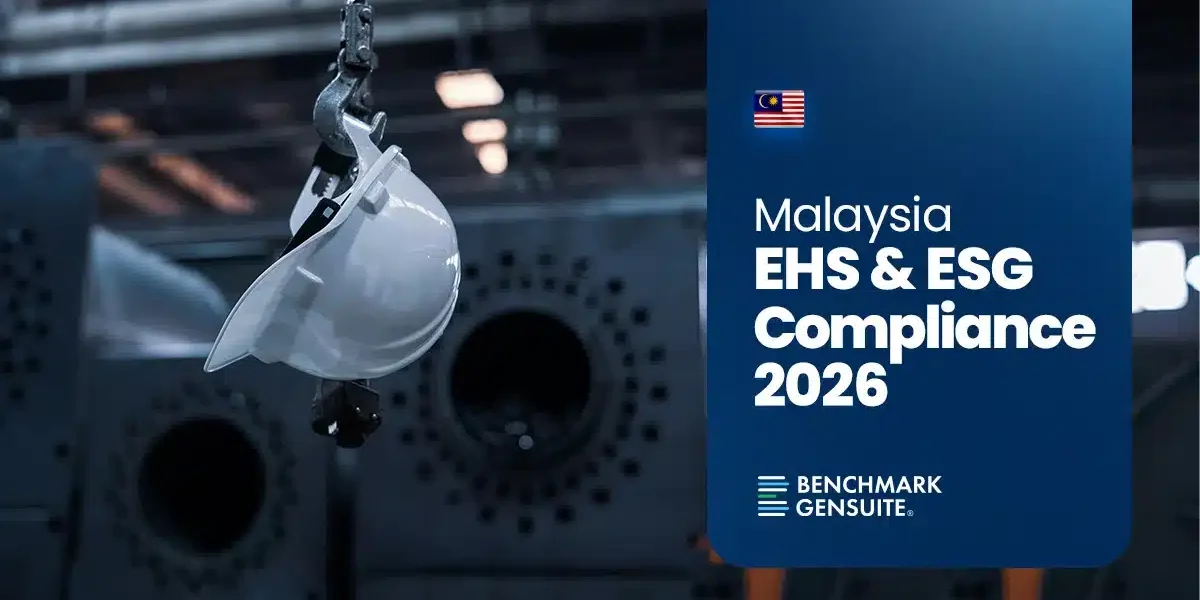
Malaysia’s evolving sustainability, chemical management, workplace safety, and climate requirements are increasing the importance of one enterprise capability: turning regulatory expectations into accountable, evidence-backed action.
For organizations operating across multiple facilities, compliance information often moves through disconnected teams and systems. Sustainability manages emissions data. EHS oversees workplace risks and chemical inventories. Compliance tracks obligations. Site teams maintain operational records.
The challenge is not simply collecting information. It is connecting requirements, owners, actions, and evidence across the business.
As Malaysia’s regulatory landscape evolves, organizations need a connected operating model that supports consistent execution—not another layer of fragmented reporting.
Four Developments Shaping Malaysia’s Compliance Priorities
1. NSRF: Stronger Sustainability Data and Assurance Readiness
Malaysia’s National Sustainability Reporting Framework (NSRF) establishes IFRS S1 and IFRS S2 as baseline sustainability disclosure standards for in-scope organizations.
Implementation is phased:
- 2025: Main Market issuers with market capitalization of RM2 billion or more
- 2026: Other Main Market listed issuers
- 2027: ACE Market issuers and qualifying non-listed companies with annual revenue of RM2 billion or more
In September 2026, the Advisory Committee on Sustainability Reporting deferred mandatory reasonable assurance of Scope 1 and 2 emissions by one year. The revised start dates are 2028 for Group 1, 2029 for Group 2, and 2030 for Group 3.
Applicable transitional relief remains available for specified disclosures, including climate-first reporting for Groups 1 and 2 during their first two annual reporting periods.
The deferral provides more preparation time, but it does not eliminate the need for reliable reporting processes and internal controls.
The operational priority: Connect emissions source data, calculations, ownership, review, and approval so reported metrics can be traced back to supporting evidence.
2. Draft PPKAS: Prepare for More Structured Chemical Management
Malaysia’s Department of Environment published an outline of proposed regulations for scheduled environmentally hazardous substances in June 2026.
The draft PPKAS framework addresses prohibited, controlled, and unintentionally produced scheduled environmentally hazardous substances. It also proposes notification, inventory, record-retention, and training requirements for relevant organizations.
These provisions remain proposals and are not enforceable requirements until finalized and gazetted.
Organizations can strengthen chemical management now by maintaining consistent substance inventories, assigned owners, supporting documents, and change histories.
The operational priority: Establish reliable chemical records that support day-to-day controls and can adapt to future requirements.
3. OSHMP30: Move From Reactive Reporting to Prevention
Malaysia’s Occupational Safety and Health Master Plan 2026–2030 (OSHMP30), launched in July 2026, sets a national target of reducing the fatal occupational injury rate to 2.20 per 100,000 workers by 2030.
Its strategic priorities include stronger OSH governance, workforce wellbeing, technology integration, risk prevention, and capability development.
OSHMP30 is a national strategic plan, not a standalone set of new employer obligations.
Its direction nevertheless reinforces the importance of identifying hazards early, assigning corrective actions, monitoring leading indicators, and sharing lessons across facilities.
The operational priority: Connect frontline observations, risk assessments, investigations, and corrective actions so management can identify emerging risks and intervene earlier.
4. Climate Policy and CBAM: Make Emissions Data Traceable
Malaysia’s proposed National Climate Change Bill adds another potential driver for more structured greenhouse gas measurement and reporting. As of 7 October 2026, the bill was awaiting Cabinet approval before parliamentary tabling and had not become law.
International market requirements are already relevant for some Malaysian exporters.
The EU Carbon Border Adjustment Mechanism (CBAM) entered its definitive regime on 1 January 2026 for selected goods, including cement, iron and steel, aluminium, fertilizers, electricity, and hydrogen.
Malaysian producers supplying covered goods to the EU may need to provide importers with traceable embedded-emissions information. The first annual CBAM declaration for 2026 imports is due in September 2027.
The operational priority: Maintain consistent emissions data and supporting records that can serve sustainability reporting, customer requests, and applicable trade requirements.
The Enterprise Challenge: Connect Requirements to Execution
These developments affect different functions, but they expose a common operational weakness. Regulatory requirements are tracked in one system, site activities are managed in another. Supporting evidence sits in shared folders, spreadsheets, or email.
As information moves between functions, accountability and context can become harder to maintain. A connected operating model brings five activities together:
- Assign accountability: Translate requirements into owned tasks, deadlines, and escalation paths.
- Capture operational data: Record inspections, incidents, chemical inventories, and environmental information at the source.
- Maintain evidence: Preserve supporting records, calculations, approvals, and change histories.
- Track corrective action: Carry findings through investigation, action, and closure verification.
- Monitor enterprise performance: Give leadership consistent visibility into overdue work, recurring risks, and reporting readiness.
The value is not limited to any single regulation. The same operational foundation can support EHS execution, sustainability reporting, internal governance, and future regulatory changes.
How Benchmark Gensuite Supports Connected Compliance Execution
Benchmark Gensuite’s AI-Forward Enterprise Management Software brings together EHS, sustainability, risk, compliance, and operational performance within a connected enterprise management approach.
Rather than managing every requirement as an isolated initiative, organizations can use digital workflows to strengthen consistency across locations and functions.
This approach supports three business priorities:
- Standardize execution across sites. Establish more consistent processes for inspections, issue reporting, corrective actions, and compliance commitments.
- Strengthen data traceability. Connect operational records with accountable owners, supporting evidence, and review processes.
- Improve management visibility. Bring relevant performance indicators and outstanding actions into a clearer enterprise view.
These capabilities support compliance execution. Organizations remain responsible for interpreting applicable requirements, establishing appropriate controls, and determining whether their systems and processes meet regulatory obligations.
A Practical 90-Day Starting Point
Organizations do not need to redesign every compliance process at once.
A focused pilot can identify where connected workflows offer the greatest operational value.
Days 1–30: Map the Evidence Trail
Select one sustainability metric, one chemical inventory process, and one workplace safety workflow.
Identify the systems, owners, manual handoffs, and evidence required to complete each process.
Days 31–60: Standardize Ownership and Controls
Define accountable owners, authoritative records, review requirements, escalation paths, and closure criteria.
Identify where information is duplicated or difficult to retrieve.
Days 61–90: Test Traceability and Visibility
Retrieve one reported metric, one substance record, and one completed safety action.
Confirm whether each has a clear source, owner, supporting evidence, approval history, and current status.
Use the findings to prioritize the next workflow for improvement.
Build a Connected Compliance Foundation Beyond 2026
Malaysia’s regulatory and policy landscape will continue to evolve.
Organizations that rely on disconnected systems will need to repeatedly reconcile information, establish ownership, and assemble evidence as expectations change.
A connected operating model provides a more consistent foundation.
Benchmark Gensuite helps enterprises connect operational requirements with accountable work, supporting evidence, and management visibility across EHS, sustainability, risk, and compliance.
Connect Your EHS and ESG Workflows
See how Benchmark Gensuite can help your organization standardize compliance execution, improve operational visibility, and strengthen evidence management across facilities.