Can leadership see which actions remain open across sites—without assembling updates from disconnected spreadsheets, documents, and emails?
These are critical questions for manufacturers preparing for FDA inspections.
With FDA announcing plans in 2025 to expand unannounced inspections of foreign manufacturing facilities, maintaining current, retrievable quality records becomes even more important.
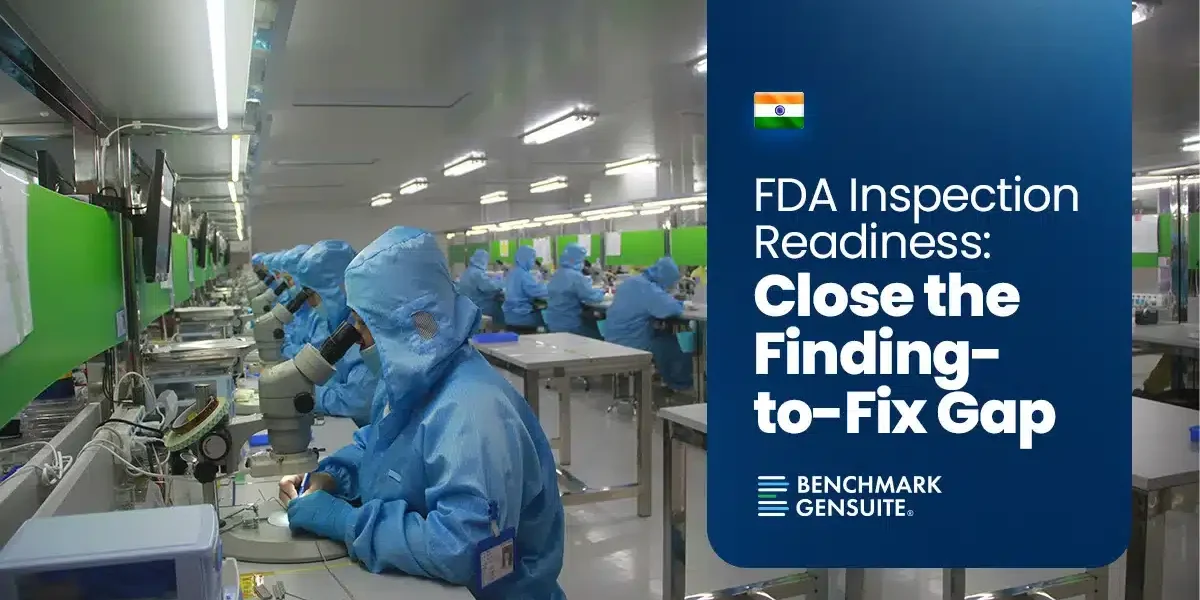
The objective is continuous inspection readiness: a traceable path from finding to verified closure.
FDA’s 2026 Draft Guidance Puts Follow-Through in Focus
FDA’s March 2026 draft guidance, Responding to FDA Form 483 Observations at the Conclusion of a Drug CGMP Inspection, emphasizes the importance of thorough investigations, documented corrective actions, and supporting evidence.
The guidance remains a nonbinding draft and is not for implementation. Its public comment period closed on 8 May 2026.
Establishments are not required to submit a written response to Form FDA 483 observations. For those that choose to respond, FDA recommends submitting the response within 15 business days of issuance.
The draft guidance recommends that responses address:
- Investigation scope, findings, and root causes
- Related systemic issues and product-quality risks
- Corrective and preventive action (CAPA) plans
- Completed and interim actions, with target dates
- Supporting evidence and management engagement
- Planned effectiveness evaluations and available results
For complex observations that cannot be fully addressed within the recommended period, the draft guidance recommends submitting a CAPA plan and proposed completion timeframe. It also recommends a consolidated response and notes that late submissions may not be considered in inspection classification.
Form FDA 483 observations are not FDA’s final determination of compliance.
The practical implication is that quality teams need reliable investigation and remediation records before an inspection—not a last-minute documentation exercise.
Connect Quality Execution From Finding to Closure
Pharmaceutical manufacturers already conduct audits, investigate discrepancies, assign corrective actions, manage controlled documents, train employees, and monitor commitments.
The challenge arises when these activities are managed independently.
Benchmark Gensuite supports a connected approach to quality execution through seven complementary applications organized around three operational priorities.
1. Identify Issues and Establish Accountability
Quality issues can emerge through planned audits, employee reports, or operational investigations.
Regulatory Auditor supports consistent audit execution through configurable checklists, scheduling, and collaboration. Findings can be transferred into Action Tracking System, reducing manual re-entry.
Quality Concern Reporting provides a centralized channel for documenting and monitoring reported quality concerns and nonconformances.
Together, these capabilities help move identified issues into a more consistent follow-up process.
Under 21 CFR 211.192, unexplained discrepancies and specified batch failures must be thoroughly investigated, even when affected batches have already been distributed.
The priority is to establish clear ownership and maintain a traceable record of the investigation and resulting actions.
2. Execute Corrective Actions and Maintain Evidence
Identifying a problem is only the first step. Quality teams must also document the response and determine whether corrective action was effective.
Action Tracking System supports action assignments, due dates, progress monitoring, and documented follow-through.
Related applications help carry decisions into operational practice:
- Doc Manager: Supports controlled document storage, retrieval, version management, and review and approval workflows.
- Training Tracker: Helps assign and monitor role-based training and completion requirements.
- Compliance Calendar: Tracks responsible owners, commitments, deadlines, and reminders.
These workflows help quality teams maintain visibility into what was assigned, what changed, and what evidence supports completion.
Organizations remain responsible for determining investigation scope, CAPA effectiveness criteria, appropriate validation, record integrity, and applicable electronic-record and electronic-signature controls.
3. Give Leadership Visibility Across Sites
A finding may be progressing toward closure at one facility while similar concerns emerge elsewhere.
Without consistent reporting, identifying recurring issues and overdue commitments can require significant manual coordination.
Dashboards & Analytics supports reporting and visualization across Benchmark Gensuite applications.
Quality leaders can use these capabilities to monitor indicators such as:
- Open findings and overdue actions
- Corrective-action progress and aging
- Recurring quality concerns
- Completion trends across sites
This supports more consistent oversight and helps leaders identify where additional attention or resources may be required.
The enterprise advantage is greater visibility into quality execution—not simply more digital records.
Proof in Practice: Lilly Uses Inspection Data to Inform Decisions
Lilly’s experience demonstrates the operational value of centralized inspection information.
The company has used Benchmark Gensuite’s Auditing and Inspection Management tools since 2014.
Its published health and safety inspection case study reports:
- 154,000+ inspections
- 22 sites
- 9 countries
By centralizing inspection information, Lilly improved visibility into activity and findings previously maintained in paper binders.
In one active pharmaceutical ingredient business unit, analysis identified extended periods without inspection findings. Lilly adjusted inspection frequency from daily to weekly and subsequently monthly, allowing teams to redirect effort toward higher-priority activities.
The case illustrates how accessible inspection data can inform operational decisions at pharmaceutical scale.
It does not establish an FDA compliance outcome or demonstrate pharmaceutical CAPA effectiveness. Results depend on each organization’s procedures, configuration, governance, and adoption.
CTA: Read the Lilly Case Study
Make Inspection Readiness Part of Daily Quality Execution
FDA inspection readiness is not created when an inspection is announced.
It is built through consistent investigations, accountable corrective actions, controlled documentation, completed training, and evidence that can be retrieved when needed.
For pharmaceutical manufacturers managing multiple facilities, these activities become more difficult to oversee when information remains fragmented.
Benchmark Gensuite helps connect the workflows supporting quality execution, giving teams a more consistent path from finding to follow-through and leaders greater visibility across sites.
Its applications support the organization’s pharmaceutical quality system. They do not replace CGMP batch-record systems, manufacturing execution systems, scientific quality decisions, or required electronic-record and electronic-signature controls.
See Connected Quality Execution in Action
Explore how Benchmark Gensuite can connect audits, quality concerns, corrective actions, controlled documents, training, compliance deadlines, and reporting across your pharmaceutical operations.
Sources
-
- U.S. FDA, FDA Form 483 Frequently Asked Questions
- U.S. FDA, Responding to FDA Form 483 Observations at the Conclusion of a Drug CGMP Inspection, Draft Guidance for Industry, March 2026. Draft—not for implementation. Comment period closed May 8, 2026.
- Electronic Code of Federal Regulations, 21 CFR 211.192: Production Record Review.
- Benchmark Gensuite, How Lilly Streamlined Audit and Inspection Management While Improving Data Quality.
- FDA to Expand Unannounced Inspections of Foreign Facilities — Manufacturers, Research Firms Should Prepare, May 2025.