Building an Intelligent Digital Ecosystem That Delivers Value for EHS and Sustainability Functions
Every organisation depends on the work EHS and Sustainability teams do every day. They help protect people, reduce risk, strengthen operational performance, support regulatory readiness, and build confidence in how the business measures and reports progress.
Much of that work happens behind the scenes. It shows up in safer operations, stronger controls, more reliable reporting, and better decisions when something changes. Yet when teams need investment, leadership support, or wider engagement, the value can be difficult to explain in financial business terms.
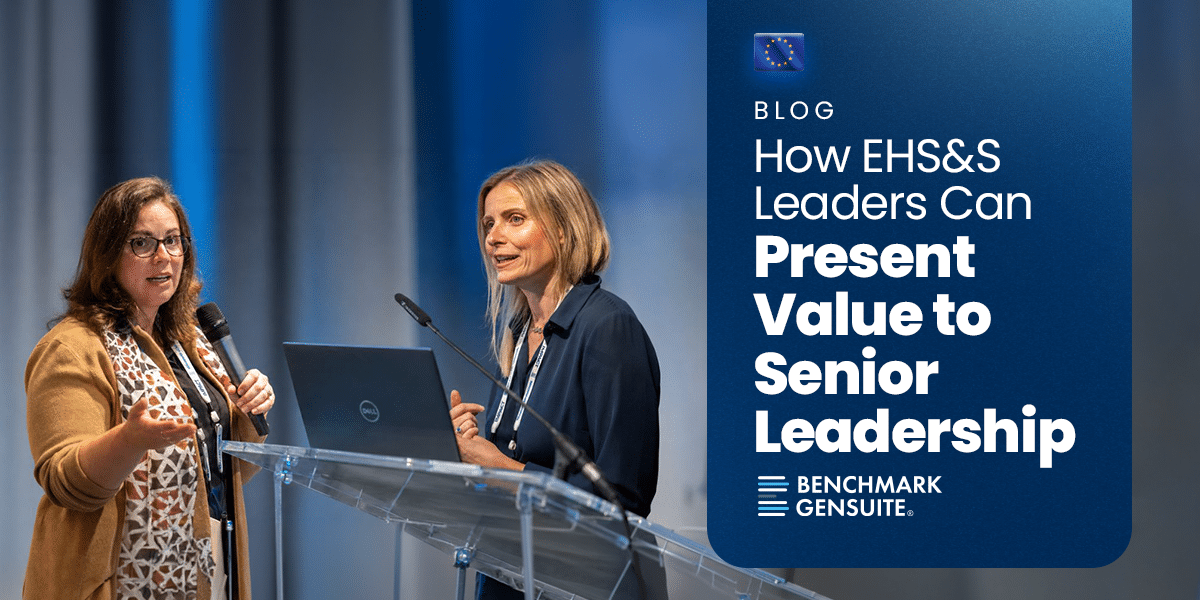
That challenge sits at the centre of the Europe IMPACT session, How to Present the Value of EHS & Sustainability to Senior Leadership, featuring Amanda Petzinger, Vice President, Sustainability, Stewardship, Supply Chain, & ESG Solutions at Benchmark Gensuite, and Stephanie Haines, Associate Director, Subscriber Development at Benchmark Gensuite, alongside special guests Katia Makshanova, Senior Analyst, EHSQ at Verdantix, and Dayann Charles, Senior Manager, Advisor Services at Verdantix. The discussion focuses on a question many EHS and Sustainability leaders recognise: how do you show that these programmes are not only necessary, but central to business resilience?
For many teams, the business case cannot stop at system capabilities. It needs to show the value created when workflows become easier to manage, data clearer to report, and insights faster to act on when digital systems are unified.
The Real Challenge: Translating Programme Value into Business Value
EHS and Sustainability leaders operate in a complex environment. Regulations continue to evolve, disclosure expectations are increasing, supply chains remain under pressure, and organisations need clearer visibility across sites, functions, and business units.
At the same time, teams are often working with fragmented systems and manual processes. Data may exist, but it may not be easy to access, compare, or trust. Workflows may be in place, but they may not give leaders the full picture of risk, performance, and progress.
This creates a communication gap. EHS and Sustainability teams understand the operational value of stronger systems because they see the daily impact. Senior leaders need to see how that investment supports the wider business.
That means connecting programme needs to outcomes leadership already cares about: risk reduction, resilience, productivity, compliance confidence, reporting readiness, and better decision-making.
A stronger value story starts with the business problem. Cleaner data supports more confident reporting. Connected workflows reduce manual follow-up. Better visibility helps leaders understand risk before it becomes harder to manage.
Why Unified Data Strengthens the Leadership Conversation
Disconnected systems make it harder to tell a clear story. When EHS, ESG, Sustainability, Quality, Security, and operational data sit across different tools, teams can struggle to compare performance, identify trends, prove progress, and respond quickly.
For senior leaders, this creates uncertainty. They may receive reports, but not always the context behind the numbers. They may see individual metrics, but not how those metrics connect across risk, compliance, operations, and sustainability performance.
A unified digital ecosystem helps bring data, workflows, and reporting into a more consistent view. That matters because leadership decisions depend on context. When information is connected, teams can explain not only what is happening, but why it matters and what needs attention next.
For Sustainability teams, reliable data supports climate performance tracking, disclosure activity, and broader sustainability initiatives. For EHS teams, connected data supports incident visibility, compliance monitoring, corrective actions, safety culture, and operational risk oversight.
The stronger the data foundation, the easier it becomes to show how EHS and Sustainability contribute to business performance.
Building a Business Case Around Outcomes, Not Features
A strong business case begins with outcomes. Senior leaders do not need every detail of a platform workflow. They need to understand what changes when teams have better visibility, cleaner data, and more consistent processes.
That could mean faster reporting cycles, reduced administrative effort, improved audit readiness, stronger risk oversight, better compliance confidence, or clearer alignment between operational performance and sustainability commitments.
Different stakeholders will also define value differently. Some will focus on risk and compliance. Others will look at productivity, cost control, resilience, investor confidence, or strategic growth.
This is where EHS and Sustainability leaders can make the conversation more relevant. The same digital investment can support many priorities, but the value needs to be framed in the way each audience understands.
Why AI Readiness Depends on Strong Digital Foundations
AI is part of the conversation, but it is not the starting point. For EHS and Sustainability teams, AI becomes meaningful when it supports real work: summarising information, surfacing insights, improving reporting, reducing manual effort, and making complex data easier to interpret.
That value depends on reliable data, clear governance, connected workflows, and practical use cases. Without those foundations, AI can create interest without delivering useful impact.
For leadership teams, this distinction matters. AI should be connected to specific needs, such as improving consistency, reducing manual review time, accelerating insight generation, or helping teams make better use of the information they already collect.
When digital foundations are strong, AI becomes easier to position as a practical enabler of better decisions, not just a future-facing technology trend.
EHS and Sustainability teams already create value across the enterprise. The opportunity is to make that value easier to see, measure, and connect to the priorities of senior leadership.
A stronger value narrative links technology investment to outcomes that matter across the business: resilience, risk reduction, productivity, compliance confidence, and better decisions.
It can also connect EHS and Sustainability to operational risk management by showing how clearer workflows and stronger visibility help organisations anticipate, manage, and respond to risk more effectively.
For teams building executive support, the goal is not simply to present the platform. It is to show the business impact that becomes possible when EHS and Sustainability data, workflows, and insights work together.
About Benchmark Gensuite
Benchmark Gensuite® delivers AI-forward, best-in-class digital EHS, Sustainability, Quality, and Risk solutions for global enterprises. Powered by a single-version, cloud-based platform and enriched by a rapidly expanding suite of generative AI tools, Benchmark Gensuite empowers more than 4 million users across industries to proactively manage risk, ensure compliance, and accelerate performance.
With over two decades of domain expertise, award-winning customer service, and a commitment to continuous innovation, Benchmark Gensuite is the trusted partner for organizations seeking both operational excellence and strategic impact.
About Verdantix
Verdantix is an independent research and advisory firm providing market-leading insights for organisations navigating EHS, Sustainability, ESG, Net Zero, Risk, Real Estate, and Industrial Operations. Through its expert research, advisory services, and recognised Green Quadrant reports, Verdantix helps enterprise leaders, technology buyers, and solution providers make confident decisions, benchmark performance, and understand the evolving digital technology landscape.