The demands on EHS teams have noticeably shifted in a relatively short period of time. Across the EHS leaders we surveyed, a common pattern emerged—one that may feel familiar to many teams navigating today’s EHS landscape. Responsibilities are growing at an accelerated pace, and many describe safety as becoming harder to manage. Incidents feel less predictable, with signals often arriving too late, and teams are feeling stretched thin in a landscape that’s more competitive, more demanding, and where visibility challenges are impacting frontline teams.
This growing strain is what our latest EHS Benchmarking Report defines as the 2026 EHS Pressure Point: the moment when rising operational complexity collides with shrinking time, attention, and resources.
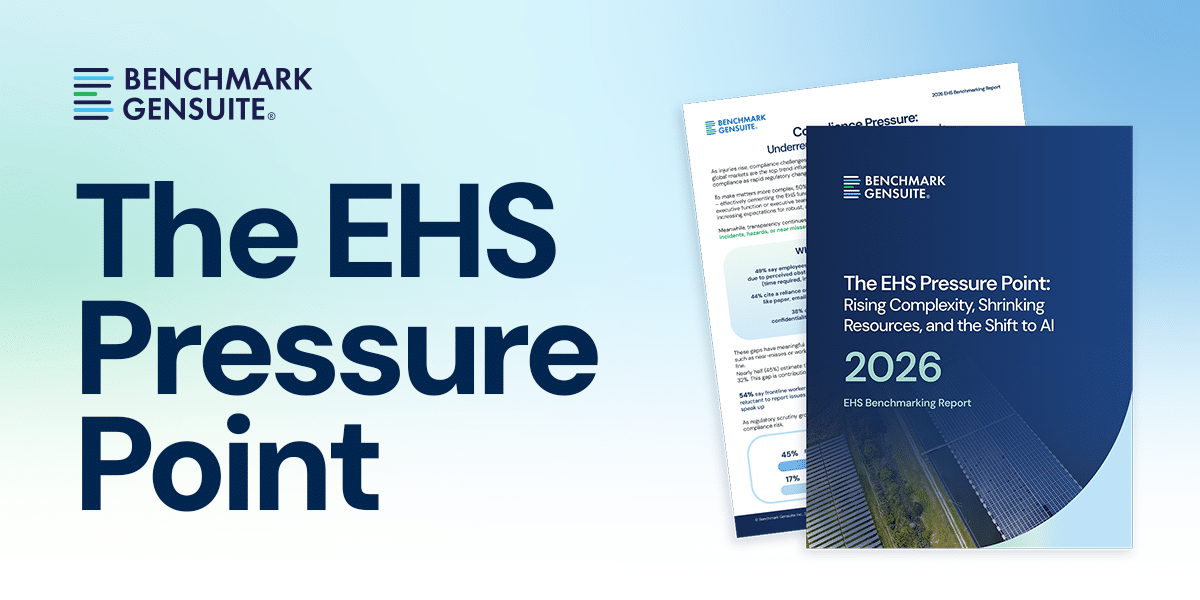
Based on insights from more than 260 EHS professionals in the broad market, the 2026 EHS Benchmarking Report captures how surveyed leaders are experiencing a moment of increasing pressure, where expectations, visibility, and capacity are converging. Download the report today to access the full data set.
EHS Safety Trends Report 2026: Rising Complexity Across Modern EHS Programs
Over the past few years, EHS leaders have been balancing competing priorities. In our 2025 Benchmarking Report, 45% of professionals said new responsibilities had intensified the complexity of their roles, limiting their ability to focus on core safety functions.
What’s different in 2026 is the volume and velocity of those demands. Half of respondents now report taking on additional data collection and stakeholder reporting, effectively positioning the EHS function as a central hub for compliance, ESG metrics, and operational insights.
In just one year, the pressure has intensified significantly. So much so that many leaders interviewed now cite increased workload and competing demands as a primary driver of workplace injuries.
Today’s teams are expected to manage:
- Expanding regulatory requirements across regions
- ESG disclosures and sustainability metrics
- Workforce volatility and skills gaps
- Real-time expectations from executive leadership
Rather than appearing as isolated challenges, these demands are converging into a broader shift in how safety performance is experienced. Across the benchmarking responses, nearly half of leaders reported injury rates rising significantly, in some cases two to three times year over year, reflecting the growing strain many teams describe.
Biggest Risks Facing EHS Teams Today: Workforce Strain and Operational Risk
Hiring challenges, high turnover, and inconsistent training environments are increasingly shaping how work is performed on the ground. In the 2026 EHS Benchmarking Report, respondents consistently link these factors to higher risk exposure, missed controls, and slower hazard response. This strain is further compounded by a persistent industry challenge: underreporting.
Many respondents described a decline in frontline visibility, with a staggering number of leaders saying workplace incidents, hazards, or near misses go underreported, up from the previous year. According to EHS leaders, the challenge is often rooted in process friction. Nearly half of respondents say workers avoid reporting because the process is time-consuming, systems are insufficient, or the steps feel tedious.
In addition, more than half of the leaders interviewed say frontline workers are reluctant to speak up for a range of reasons outlined in the report—an important dynamic that raises questions about how much risk data ultimately reaches formal reporting systems.
What makes this trend particularly complex is how it develops over time, often without immediate or obvious indicators. Workforce instability rarely causes immediate spikes in incidents. Instead, it can erode safety margins over time. By the time issues appear in lagging indicators, opportunities for early intervention may already be limited.
The issue isn’t just that incidents occur. It’s how often teams say, “We didn’t see it coming,” even though the signals were there—they just weren’t captured by existing tools.
See how an AI-powered frontline safety software transforms reporting.
The Resource Gap: Why Many EHS Teams Are at a Turning Point
Beyond workforce instability and reporting gaps, another pressure point appears consistently across the data: limited resources. The benchmarking study shows that lack of budget, people, and support is the number one concern keeping EHS professionals up at night.
This shortage is unfolding at the same time responsibilities are expanding, reporting demands are increasing, and safety programs are expected to deliver faster, more precise insights to leadership.
With more than a third of surveyed organizations still relying heavily on manual processes and spreadsheets, some EHS leaders described feeling pulled into reactive work, spending more time locating or reconciling information than acting on it. Over time, that dynamic can reduce the space teams have for proactive safety leadership.
Are EHS Leaders Using Generative AI? How EHS Workflows Are Evolving
As expectations continue to grow, many leaders are beginning to explore how technology can help extend team capacity—particularly in environments where headcount and resources may not scale at the same pace as demand.
Many surveyed leaders describe actively using AI to support reporting workflows, analyze large volumes of data, and reduce administrative burden across their programs.
According to the benchmarking study, 92% of respondents are personally using generative AI in at least some part of their day-to-day EHS work. Rather than replacing existing processes, these tools are often being applied to support tasks such as summarizing incident narratives, preparing documentation, building dashboards, or identifying patterns within existing data sets.
Early examples from Benchmark Gensuite subscribers illustrate how organizations are exploring these capabilities. In just two quarters, Benchmark Gensuite’s Genny AI helped companies reclaim more than 15,900 hours of work.
The benchmarking findings suggest that AI is becoming one of several approaches surveyed leaders are evaluating as they rethink how EHS work gets done.
Future of EHS in 2026: Key Takeaways from the Benchmarking Report
Across the responses gathered in the 2026 EHS Benchmarking Report, it’s possible that many leaders are navigating a moment of transition. Rising expectations, evolving workforce dynamics, and growing data demands are reshaping how safety programs operate, often faster than traditional approaches can adapt.
For leaders trying to understand where the pressure is coming from, and how peers are responding, the full report offers deeper context, additional data points, and practical perspectives from more than 260 EHS professionals.
Download the full 2026 EHS Benchmarking Report to explore the complete findings and key trends shaping the future of EHS.