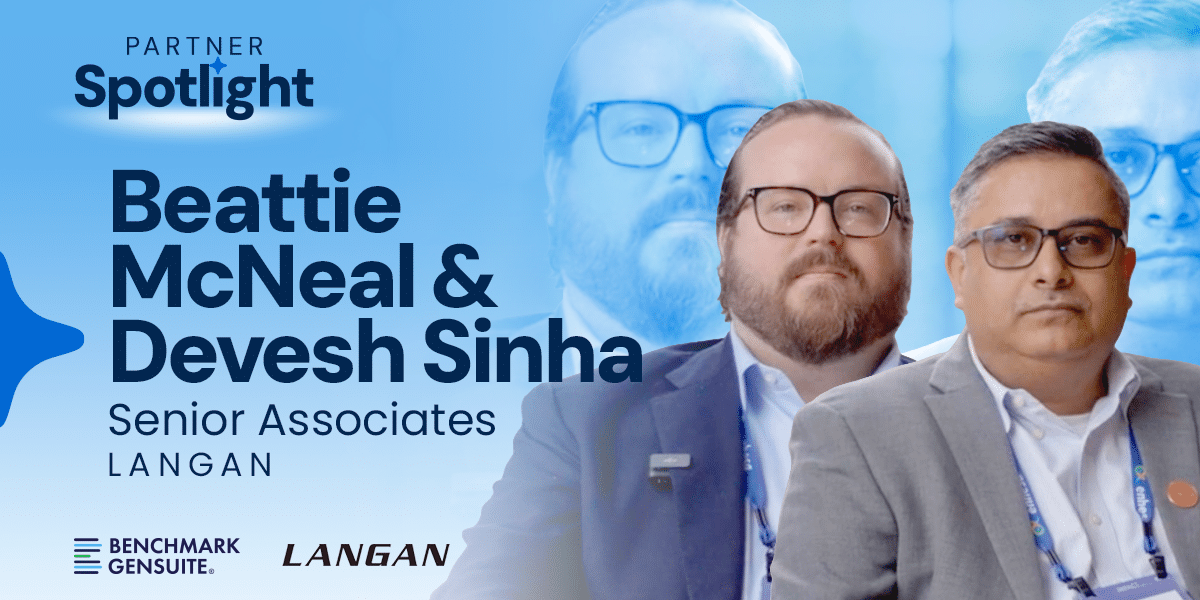
Operationalizing EHS: How Practical Partnerships Help Organizations Navigate Complexity
For Beattie McNeal and Devesh Sinha of Langan Engineering & Environmental Services, one of the biggest challenges organizations face today is not simply managing EHS data or implementing new technology—it’s understanding how to build solutions that reflect the realities of their operations. As regulatory expectations evolve, businesses grow, and technology advances, organizations are looking for partners that can help them navigate complexity in practical, adaptable ways.
Through their work with clients across industries, Beattie and Devesh have seen how successful EHS programs depend on more than just software. They require a clear understanding of operational maturity, flexibility in how solutions are applied, and a willingness to meet organizations where they are. That shared philosophy is also what has shaped Langan’s relationship with Benchmark Gensuite: a focus on collaboration, practical problem-solving, and helping clients turn technology into long-term operational value.
Key Takeaways from Beattie McNeal and Devesh Sinha for Modern EHS Programs
- Strong EHS programs start with understanding operations: Effective solutions come from understanding how organizations actually work before introducing technology or process changes.
- Flexibility matters as much as methodology: Organizations need partners that can adapt to different levels of operational maturity and evolving business needs.
- Technology works best when it supports practical outcomes: AI and automation create the most value when they simplify complex processes and reduce barriers for employees.
- Partnership is built through collaboration and responsiveness: Long-term success depends on listening to feedback, adapting solutions, and focusing on real operational challenges together.
- Operational improvement is iterative: Organizations gain the most value when EHS programs, processes, and technology evolve together over time.
How has Langan’s approach to EHS services evolved over the years?
Devesh: Langan is a more than 50-year-old firm. We started by doing engineering work for clients across North America and have since expanded our work to more than 100 countries around the world.
As the company grew and helped clients build infrastructure, we also saw the value of EHS services. Over time, we’ve continued growing that part of the business to support both existing and new clients who want to benefit from our technical expertise.
Our value proposition has always been to be technically sound, demonstrate practical experience, and be responsive to our clients. Those are values we also see reflected in Benchmark Gensuite. It’s a company we’ve seen evolve into a technically excellent product, and you can see the passion from the clients here and how responsive the organization is.
What are some of the biggest challenges clients are trying to navigate right now?
Beattie: There are definitely some common themes. One of the biggest over the last 18 months has been the uncertainty and constantly changing legislative environment around the world.
Whether it’s new sustainability laws, evolving EPA or OSHA regulations, or broader compliance expectations, it’s been a very dynamic environment for our clients to navigate. We’ve been fortunate to partner with them and help guide them through those times.
Devesh: Clients come to us because they want trusted partners. Our services help them manage operational risk and maintain continuity while adapting to changing business and regulatory environments.
Some clients are dealing with a changing landscape, while others are preparing for growth and trying to understand how they should prepare for it. That’s very much how Langan has grown as well. We look at where the market wants to go, what the demand from the market is, and then we build based on that.
Has technology always been part of Langan’s approach, or has that evolved alongside your EHS services?
Devesh: Langan has had a technology services business for a long time. Langan was one of the first firms that started this whole mobility program. What we recommended to clients was also what we implemented internally, so employees had access to mobile technology long before devices like iPads became standard.
As EHS services have matured for clients over the last nine years, the services we provide have helped clients select software, optimize their programs so they’re ready for software, and then implement and maintain those systems so they can gain operational efficiency.
When engaging with a new client, how do you begin identifying what they truly need?
Beattie: We’re a results-oriented firm, and we like working with clients who are results-oriented as well.
The first thing we want to understand is what the client is actually trying to achieve. Whether that information is metadata, environmental permits, health and safety data, ESG data, or product stewardship information, all of that is really just a step toward helping solve whatever problem they’re looking to solve.
Devesh: We do have a strong methodology behind our process, but we also try to stay agile enough to match the client’s maturity level.
There’s a “seek to understand” aspect to our work. We get to understand the client’s operations very well before we start thinking about what solutions would work for them.
We want to be embedded as them. It’s not an external consultant providing services. That is our first step: getting to know them more and understanding what the key challenges are. Some of those challenges are not technology-related. As we say, it’s not the tool, it’s everything around it. And that’s what we want to work on.
How do you help organizations move from operational challenges to long-term EHS improvement?
Devesh: Langan brings together three areas of expertise: the operational side of the client’s business, EHS subject matter expertise, and technology expertise. Success comes from combining all three.
It’s also a very iterative process. Organizations don’t go from point A to point B overnight. We work in stages that align with the client’s maturity, and then build solutions together from there.
Beattie: Devesh mentioned the three pillars, and it’s critical that all three are fit for purpose. You can’t have a tool that doesn’t align with operations. At the same time, operational processes may need to evolve to better align with EHS management systems or the technology itself. Each area has to adapt a little in order for everything to work together successfully.
Where do organizations tend to gain the most value from EHS platforms over time?
Devesh: Organizations have already invested in a strong platform. Our role is to help them maximize the value they get from it.
We can see they are actively using it and providing feedback that the organization is continuing to build on. We like working in that kind of environment with our clients. That’s true partnership.
We really want to partner with them and help them maximize the value they can get from the product. As Beattie said earlier, the product is one aspect of the success story. The other is understanding how it helps the organization itself.
We are also partnering with Benchmark Gensuite directly and actively discussing how the product can integrate in multiple ways so clients can maximize value from one module to another. Those are some of our value propositions.
Discover what EHS & Sustainability leaders can Expect from Benchmark Gensuite’s integrated platform
Beattie: Where we really feel a cultural fit with Gensuite is that we’ve talked in depth about how people, process, and tools all need to work together, and Benchmark has a unique ability to be flexible and accept user feedback. We’ve seen many examples over the years where customer input led to improvements that benefited everyone.
Langan and Benchmark Gensuite are very aligned in that way. Both organizations are open to feedback, have no ego, and focus on meeting clients where they are.
What made this partnership feel like the right fit for both organizations?
Devesh: As we shared, Langan is always thinking inwards and looking outwards. We’re always introspecting and asking ourselves whether we’re getting prepared with the right services for the clients we want to support.
We looked for products that were ready for operationalizing EHS, and Benchmark Gensuite was one of the products we saw.
AI has also been in the minds of Langan folks. What we wanted to do with AI was demystify that aspect. AI is not something from last year—it’s been around for 20 or 40 years, before any of us got into this industry. We want to get the best out of it.
We saw a partner in Gensuite who could help us with both of those thought processes. Langan had already been working with clients alongside Benchmark Gensuite, even before we formally partnered together.
That helped strengthen the case for how the technology and the consulting services could help our clients. It became less hypothetical to become partners and more practical to bring our technical expertise together to provide practical solutions for clients.
Read more on how collaborative innovation with your software provider shapes real EHS improvements.
How are you seeing AI reshape the EHS landscape for organizations today?
Beattie: I think the low-hanging fruit when anybody talks about AI is the advent of ChatGPT and many of the other similar AI models writing students’ term papers and things like that. There’s certainly been a deluge of AI implementation there, and it’s definitely had an effect on society.
But, more specifically in the EHS space, we’ve seen a lot of AI integrations in places where it can create efficiencies, lower barriers to entry, and help simplify complex processes.
One example we saw today was how Benchmark has implemented AI into SDS analysis and imports. There are a lot of different solutions to that problem, but historically it’s been a rather laborious process to double-check and ensure quality there. The implementation of Genny AI is another measure to lower that barrier to entry.
Another example we’ve seen is a lot of the automation and AI around forms and repeatable tasks. The way we see it is that the more you can lower the fence that divides people from being able to do their job, the better they’ll be able to do their job, the better retention rates you’ll get, and the more successful the organization will become.
That’s why I think Benchmark has done a good job with Genny AI. Instead of making customers figure out what they could possibly do with it, they’re figuring out ways to pull it into the application so customers can see the benefit without having to fully educate themselves on exactly how something can be applied.
Discover how Genny AI powers work across applications reducing manual effort and scaling execution.
Devesh: We see that with your subscribers. It’s a very active engagement where the practical use of AI will be very well done. There’s no fluff in the discussion. It’s questions like, “Can you do this?” “Can you do translation?” “Can you automate this process?” Those are real-world scenarios that are being captured.
What kinds of solutions are you focused on bringing to customers right now?
Devesh: We have been jointly discussing exactly your question: what are we doing for customers together?
Benchmark Gensuite has technical capabilities that customers will gain value from, and we are focusing on key industries that would benefit from these solutions.
We are also working together to bring almost packaged solutions, so clients don’t have to relearn things every time. These are solutions that have already been tested and proven in the industry, and we’ll help them with a starter kit.
That’s our viewpoint. We want to help clients across different sectors have something tailored to them but not customize it so much that it becomes a major upgrade effort when they move forward.
Final Reflections: Building EHS Solutions Around Real Operational Needs
Beattie McNeal and Devesh Sinha’s perspective highlights an important shift happening across EHS programs today: organizations are looking for solutions that adapt to their operations, not the other way around. As technology capabilities continue to expand, the real challenge is understanding how to apply those tools in practical ways that align with operational realities, workforce needs, and long-term business goals.