Why Visual Literacy and Human Capability Matter in the Future of EHS
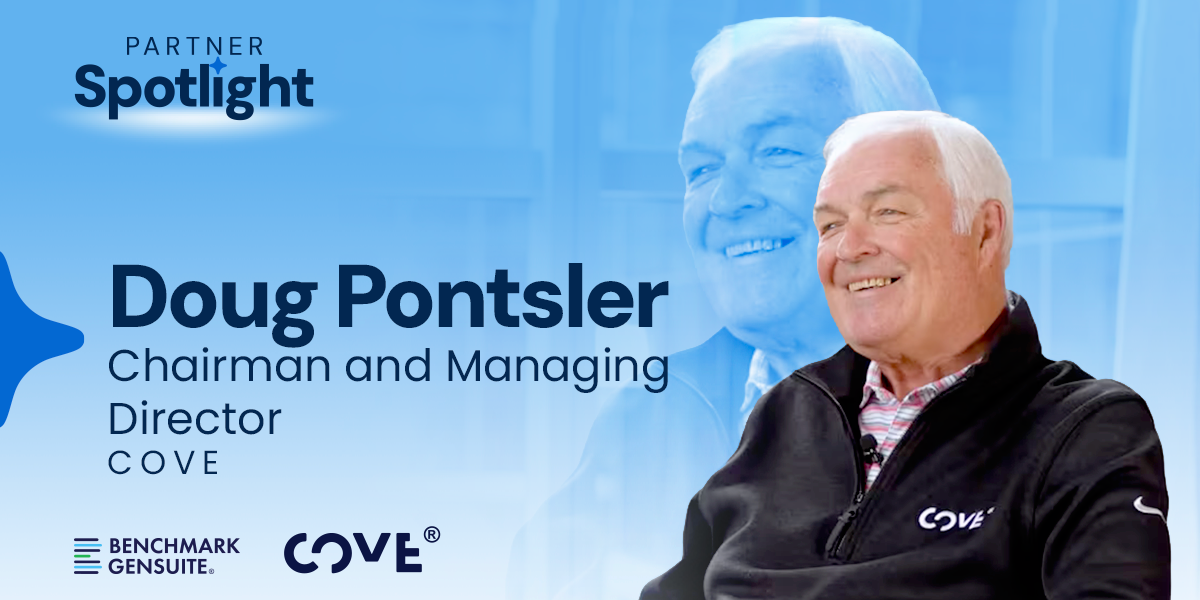
Doug Pontsler, Chairman and Managing Director at COVE: Center of Visual Expertise, is a leading authority on how people perceive hazards and why they often miss what’s right in front of them. Through COVE’s partnership with Benchmark Gensuite, Doug has seen how strengthening frontline awareness leads to better inputs, whether through visual literacy or structured digital processes, which in turn drives better outputs from AI, computer vision, and other emerging technologies. In this Q&A, he shares why familiarity can blind workers to risk, how visual literacy prepares teams to use new technology with confidence, and why human judgment remains essential even as AI helps scale prevention.
Key Takeaways from Doug Pontsler for Stronger EHS
- Visual literacy changes what people see helping workers recognize overlooked hazards, break through familiarity blindness, and engage more proactively in risk identification.
- AI and computer vision can scale prevention providing broader coverage and faster detection, but they must evolve alongside human capability, not replace it.
- Technology and competency are the future. The strongest safety programs invest in digital solutions and in building the skills workers need to identify risk independently.
- Now is the time for innovation, after decades of improvement, safety performance has plateaued; new tools, like AI, are essential to drive the next step change.
What makes collaboration within the safety community different from other industry spaces?
Doug: It’s a group of people that are very open with each other because the purpose is bigger than a competitive advantage or anything like that. At other industry conferences you had to really be careful about what you said because you were protecting your competitive advantage. But when you go to a safety conference, it’s not that way. Everyone wants to talk about innovation. We don’t create a competitive advantage by keeping secrets on how to protect people.
Over your career leading EHS and sustainability at large enterprises, how have you seen the role technology plays evolve?
Doug: There’s no doubt in the last 10 to 20 years, the role technology is playing is significant. Not only in leveraging technology to protect people directly, like the use of drones to replace high risk work with objects that can’t get hurt. But also, in how we collect data, how we draw insights. Technology tools and applications just like Benchmark Gensuite are escalating in what they have the capability to do.
From your conversations with EHS peers today, what challenges do you see organizations struggling with, and where can technology make a meaningful difference?
Doug: We’re coming off a challenging time with COVID, and I think that still has its remnants that are having an impact in the workplace. Connecting with people is all about what safety often is, hearing their concerns; they’re on the front line, they know where the hazards are, they know what the risk is. Being able to connect with them and understand their perspective is important.
Instead of being able to look at somebody in the eye and talk to them one-on-one, a lot of the work was remote or it was through virtual means, which was better than not at all, but it still wasn’t as effective as being able to be there and see things. And as a result, I think we’re regaining some ground that might’ve been lost through COVID. In terms of the role that applications can play in helping advance our work and being able to provide an environment and engage our people in a way that keeps them safe, a lot of it’s about having data that provides insights; “What is it that we need to go do?”, “What are the things that we need to go fix?”, “Where should our attention be placed?”. AI gives us better insights into where to spend our time, where to make our investments, and where we can have the biggest impact.
Discover how Genny AI Helpers help companies improve data quality by spotting inconsistencies and delivering suggestions
For those new to the concept, how does visual literacy fit into the way organizations approach hazard recognition and safer operations?
Doug: Visual literacy and the work that we do at Cove gives us an ability to better interpret the environment that we’re in because we see things at a higher level of detail. We create a safer workplace by being able to see things that we look past day after day, because they’ve become so familiar to us, we no longer see them.
What we do is borrow lessons from art education. When we look at a work of art how do we see detail? How do we draw meaning from that work of art that we’re looking at, and how does it affect us in terms of our beliefs, the actions we might take? The same thing happens in the workplace every day. We go into the workplace and at home. We’re drawing conclusions in terms of what might be safe or what might not be safe and making sure we’re avoiding the things that are not safe.
How do you see collaboration between EHS technology providers, like Benchmark Gensuite, and COVE contributing to safer workplaces?
Doug: The Cove and Benchmark Gensuite relationship goes back to almost eight years ago when I sat down at a lunch table at a conference with Natasha Porter and Amanda Petzinger. The thing that brought us together in that conversation was that at whatever level of sophistication the applications you’re utilizing, they all require inputs. Some of those inputs with today’s technology can be drawn through sensors and cameras and that sort of things, but a lot of the inputs that end up in the system are actual observations that people have.
So, if we’re able to improve their ability to see more inputs and be able to describe them at a higher level of quality, then the output that we get from whatever process we’re involved with are going to be improved. When we think about the Benchmark Gensuite suite of applications, wherever there’s inputs that are dependent upon people being able to make observations about their environment and their activities, if they’re better at that by being visually literate, then the quality and the quantity of what goes in the system will be better, which translates ultimately into better insights.
How does visual literacy make a difference in an organization’s EHS programs?
Doug: We have an Owens Corning case study that was about how we had integrated visual literacy into their hazard identification process. We like to connect visual literacy to processes and outcomes, and that case study was about improving the hazard recognition process at Owens Corning by enabling the people that do those processes to be visually literate.
When we talk about the improvements that we should see from being visually literate in the workplace, it all boils down to being able to see things that we might look over. When things become familiar to us, we just no longer see them. If we take our visual literacy tools and begin to apply them to the work that we’re doing, we begin to see more.
We have other case studies in industrial settings where people that trained in visual literacy go back into the workplace and identify 30 to 40% more hazards than what they did before. These are not hazards that just showed up overnight — they’ve been there.
Now when we have an incident, we all take care of it then. And often we’ll hear somebody say, “I’ve walked by that a thousand times, and I never saw it until the incident informed us.” Our work is about how we see that proactively, because no one wants to volunteer to be the next incident. It’s really important that we’re able to do that in advance of an injury occurring, and visual literacy gives us a set of tools that enables us to do that.
With the growth of technologies like AI, or computer vision, how do you see technology and human expertise working together?
Doug: Our point of view at Cove around computer vision and AI is that we ought to be growing, developing, and advancing it as quickly as we’re able to, because it gives us a reliable and scalable approach. The real questions are how long it will take us to get there and what sort of coverage we will need.
But at the same time, we need to continue building individuals’ capacity and capability where we don’t have cameras or computer vision deployed, so people can be more effective in their own personal competency. We believe it’s a technology conversation and a personal competency conversation— “and” not an “or” conversation.
Do you believe is important for organizations to rethink how they identify hazards and manage risk, considering the current landscape?
Doug: I think now is the time, because when we look at our history and the macro metrics associated with how well organizations perform from a safety standpoint, it’s well documented that over a long period of time we’ve seen significant improvement in the day-to-day incidents that occur in organizations, but that improvement has flattened. And in the case of serious injuries and fatalities, it has not only flattened but, there has been some amount of increase.
Both of those trends would tell us that we need something new, we need something different, we need something innovative to be able to continue driving improvement. Technology is one of those answers in terms of what can create a step change in our safety performance.
Explore our 2025 EHS Benchmarking Report and learn what over 100 EHS professionals have to say about their top challenges and technology’s role in improving safety performance.
From Cove’s experience collaborating with EHS software providers, what do you believe defines a strong and effective partnership?
Doug: There are a couple of things that really stand out to me about Benchmark Gensuite. The first one is this intense focus on the voice of the customer. I probably realized it a few years ago while attending these conferences—the agendas have really been directed at listening to the feedback and input from your client base. And that’s one of the differences Benchmark Gensuite exhibits compared to what I see in other cases. It’s also something we at Cove that we hope to replicate as well.
I think the other thing I hear from the Benchmark Gensuite team is that they want to solve real problems. They want their efforts to go toward not on theoretical ideas but on what are the actual pain points, what are the problems to be solved, let’s focus on those. One of the ways that works in the relationship we have at Cove with Benchmark Gensuite is that we’re always talking about where we have opportunities to collaborate, not only together, but also with a joint client, for example, in order to create something that would be new, innovative, and impactful.
Want to learn more? Explore our on-demand webinar with Cove and learn how Benchmark Gensuite integrated visual literacy and generative AI, helping organizations strengthen their safety culture.
Final Reflections: Advancing Safety Through Human Insight and AI Innovations
Doug’s insights highlight a defining shift in EHS: technology is accelerating rapidly, but progress depends on our ability to pair innovation with strong human judgment. Visual literacy gives workers a sharper lens for recognizing risk, while advanced EHS systems amplify those observations into actionable intelligence. The partnership between COVE and Benchmark Gensuite shows that organizations don’t have to choose between AI and people—they benefit most by investing in both. As teams learn to see what matters and digital tools scale that awareness, safety performance can move beyond today’s plateau. The next era of EHS will belong to companies that unite human capability and digital innovation to drive meaningful, lasting improvement.