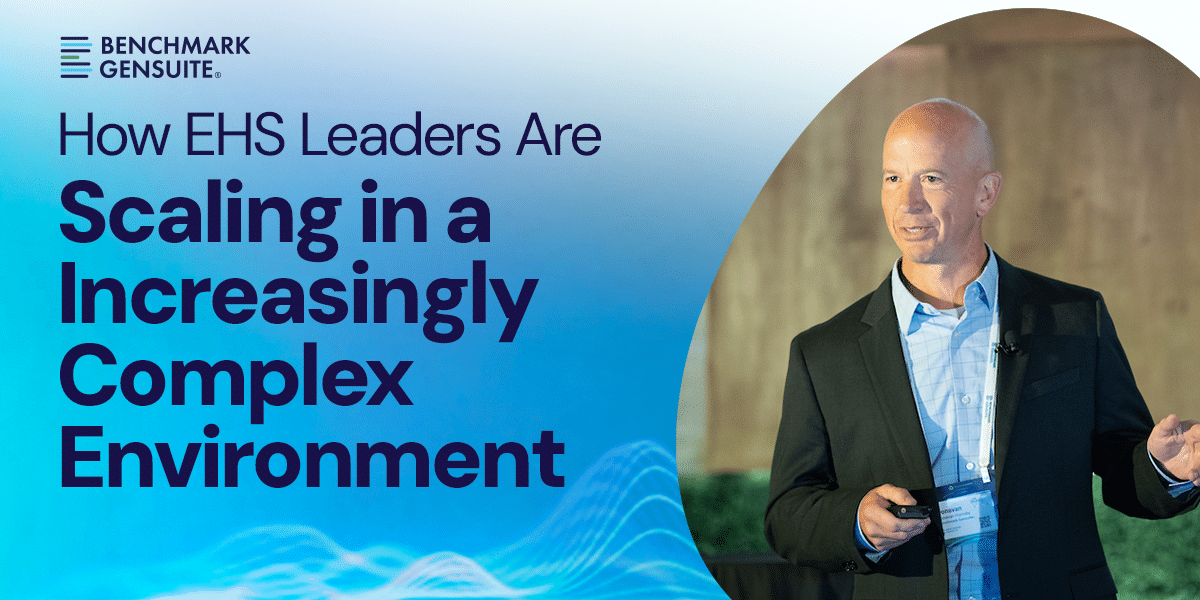
After reviewing the findings from the 2026 EHS Benchmarking Report, Donavan Hornsby, Chief Strategy Officer at Benchmark Gensuite, sat down with EHS Today’s Nicole Stempak on the “Talking EHS” podcast to discuss what the data means for EHS leaders and how they are adapting to a more complex operating environment.
In this conversation, Donavan reflects on how the role of Environmental Health and Safety leaders is evolving, why traditional approaches are becoming harder to sustain, and how leaders are thinking about scaling their impact without proportional increases in resources. This blog contains a summary of Donavan’s answers. Listen to the full podcast here.
Key Highlight from Donavan’s Conversation:
- EHS leaders are not lacking awareness—the challenge is scale. As expectations expand across safety, sustainability, and risk, many teams are being asked to do more without proportional increases in resources.
- Complexity is increasing across multiple fronts. From workforce turnover to supply chain disruptions and contractor risk, the operating environment is becoming more difficult to manage using traditional approaches.
- Visibility into risk remains a challenge. Even with increased investment in systems and processes, capturing early signals—such as near misses and worker feedback—continues to be an area of focus.
- AI for EHS is shifting from concept to practical application. Leaders are beginning to explore how AI can help surface hidden risks, support decision-making, and validate experience with data while keeping a human in the loop.
What is changing the most in the EHS landscape right now?
Donavan: Operational leaders and safety leaders have always dealt with complexity, but what we’re seeing now is an expansion of that complexity across multiple fronts. Production demands are increasing, supply chains are shifting, and workforce dynamics continue to evolve.
At the same time, EHS leaders are taking on more responsibility. It’s not just safety anymore—they’re being asked to contribute across sustainability, ESG, and broader operational risk. That combination is what’s creating pressure.
The Benchmark Gensuite 2026 EHS Benchmarking report highlights rising injuries in some organizations. What do you make of that?
Donavan: It was a surprise at first, but when you look at some of the underlying factors, it starts to make more sense. For example, increased reliance on contractors introduces new variables—people who may not be as familiar with the environment or fully trained on specific risks.
It’s also important to clarify that these findings reflect what leaders are seeing within their own organizations, not necessarily the industry as a whole.
Another dynamic is that while many organizations have done a good job reducing minor incidents over time, more serious incidents have not followed the same downward trend. That’s why there’s so much focus on SIF prevention right now.
One of the themes in the 2026 EHS report is underreporting. What stood out to you there?
Donavan: Underreporting was one of the more surprising findings. There has been a lot of investment over the years to make reporting easier—whether through systems, processes, or culture. So, to see that challenges still exist in this area suggests there’s more work to do.
Often, the issue comes down to friction. If reporting is time-consuming or difficult, it becomes harder to capture the kind of near-miss and observational data that can help prevent more serious incidents.
With increasing complexity and limited resources for EHS teams, how are leaders thinking about scaling their programs?
Donavan: One of the realities organizations are facing is that resources don’t scale at the same pace as expectations. There isn’t an unlimited ability to add people or expand teams. So, the conversation is shifting toward how to scale impact differently.
That includes looking at how work is structured, how information flows, and how quickly teams can move from identifying a risk to taking action.
It also means learning from others. One of the biggest opportunities in this space is sharing best practices. The worst thing organizations can do is try to solve these challenges in isolation when there are peers facing similar issues.
Where does technology—and specifically AI—fit into this shift in complexity for the EHS industry?
Donavan: There’s a lot of discussion around AI right now, and understandably so. What’s encouraging is that we’re seeing a shift from awareness to willingness—leaders are starting to explore how AI can be applied in practical ways.
For example, instead of manually reviewing large volumes of data, AI can help surface patterns and identify risks that might otherwise go unnoticed.
In the past, leaders often had to rely on experience and gut instinct. What’s changing now is the ability to validate those instincts with data.
That said, it’s important to keep a human in the loop. AI should support decision-making, not replace it.
What are frontline workers saying about safety, usability, and reporting in today’s EHS environments?
Donavan: Frontline workers are less concerned with complexity and more focused on usability.
People across the workforce want to feel connected and enabled to do their best work—but that only happens when safety processes fit naturally into how they already work.
That’s where usability becomes critical. If systems or processes are difficult to use, they become barriers rather than enablers. The simpler and more intuitive we can make those experiences, the more likely we are to see meaningful engagement. That’s especially important when it comes to reporting and capturing feedback. The easier it is, the more visibility organizations will have into what’s happening on the ground.
Looking ahead, what should EHS leaders focus on to scale their programs effectively?
Donavan: I think this is a moment of transition. The fundamentals of safety haven’t changed—but the environment in which those fundamentals are applied has.
Leaders should focus on how they can better connect people, processes, and data, and how they can use technology to support that.
Most importantly, they should continue to engage their teams, learn from peers, and stay open to new approaches. That’s where the biggest gains will come from.
For more insights and data from over 260 EHS professionals, download the full 2026 EHS Benchmarking Report.