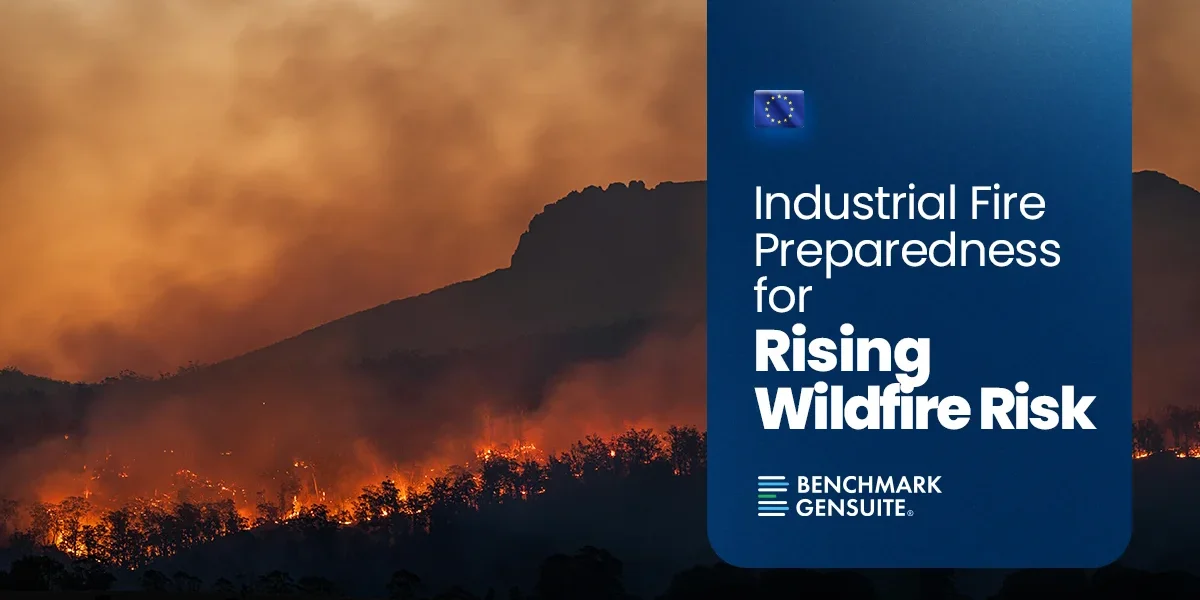
Beyond the Fireline: What Rising Wildfire Risk Means for Industrial Safety
The first warning may not be a wall of flames.
It may be smoke on the horizon, a change in wind direction or an alert that a nearby road has closed. The fire itself may still be kilometres away, but conditions inside an industrial facility can already be changing.
Heat can affect outdoor work. Emergency services may be responding across a wider area. Access routes can become evacuation routes. For sites handling fuels, chemicals, explosives or other hazardous materials, teams may also need to reassess whether work can continue safely and whether critical safeguards remain available.
Wildfire risk does not begin at the site boundary.
External hazards can turn separate operational risks into a single enterprise exposure. Preparedness depends on seeing those risks together before conditions escalate.
Wildfire Risk Is Becoming an Industrial Risk
Climate-related hazards across Europe, including heatwaves, droughts and wildfires, are becoming more frequent and severe. Exposure varies by location, but severe fire conditions are no longer relevant only to areas historically associated with Mediterranean wildfires.
For industrial operators, this raises an important question. Do existing assumptions about fire exposure, safeguards and emergency arrangements still reflect the conditions sites may now face?
A site may not be directly threatened by flames, yet smoke, heat, transport disruption, unavailable utilities or stretched emergency services can already change operating conditions. Where hazardous materials or safety-critical equipment are involved, the consequences can extend beyond the original wildfire.
When an External Hazard Changes the Operating Environment
A recent wildfire in south-west France demonstrated how environmental and industrial risks can intersect.
The fire began near Saumos, west of Bordeaux, following heat and drought that had left surrounding vegetation highly combustible. As conditions developed, large areas were affected and communities were evacuated.
Industrial operations were also located within the affected region, including Seveso-classified sites and facilities handling flammable, explosive or reactive materials. Authorities and operators introduced additional protective measures as conditions changed, including evacuation, site securing, vegetation clearance and protection of sensitive equipment.
The broader lesson extends beyond one event.
A fast-moving external hazard can change industrial operating conditions within hours. Preparedness measures therefore depend on understanding how changing external conditions interact with risks already present inside the site.
Source: Le Monde, “Wildfire in southwest France highlights Seveso sites’ vulnerability to forest fires”, 28 July 2026.
Wildfire Risk Does Not Stop at the Site Boundary
The interaction between a natural hazard and an industrial installation is often described as a natural hazard-triggered technological event, or Natech event.
Wildfire can affect industrial operations in several ways before direct flame contact occurs.
| External Condition | Potential Industrial Consequence |
|---|---|
| Smoke and extreme heat | Worker exposure and changing work conditions |
| Road closures | Restricted access, evacuation and emergency response |
| Power, water or communications disruption | Reduced operational or emergency capability |
| Embers and radiant heat | Exposure of buildings, tanks, pipelines and equipment |
| Fire reaching hazardous materials | Potential secondary fire, release or escalation |
The significance of these risks varies by site. Vegetation, weather, hazardous inventories, process design, fire protection and local response capacity all influence exposure.
The strategic question is whether these factors are being assessed together.
The Real Risk May Be the Combined Picture
Preparation begins well before smoke is visible.
Prolonged heat, dry vegetation, strong winds, nearby fire activity or an unavailable suppression system can change the significance of otherwise familiar work. Hot work, maintenance, machinery, electrical systems and vehicle activity can all introduce potential ignition sources.
The greater challenge is that the information needed to understand the combined risk may sit across different programmes.
A vegetation issue may sit in an inspection record. A fire pump may have an open maintenance action. An emergency exercise may have identified a weakness in site access. A change in hazardous-material storage may be documented elsewhere.
Each issue may appear manageable in isolation.
During a period of elevated fire danger, the combined picture may reveal much greater exposure.
That is the connected-risk problem.
Connect the Information Before Conditions Change
Industrial fire preparedness depends on more than collecting individual records. Teams need to understand how hazards, safeguards, work activities, worker exposure and unresolved actions interact as conditions change.
A connected EHS operating model can help create that shared picture.
Within Benchmark Gensuite, connected workflows can support different elements of prevention, preparedness and follow-through. Risk assessments can identify changing hazards. Control of Work processes can support decisions around hot work and other potential ignition sources. Impairment information can highlight unavailable safeguards, while Industrial hygiene information can support assessment of smoke, airborne contaminants and extreme heat.
For facilities handling hazardous materials, process safety information can help teams understand inventories, process hazards and safeguards that may influence escalation risk. Incident and corrective-action records can help ensure lessons from exercises and events are carried into future preparedness.
The enterprise value does not come from treating these as separate activities. It comes from connecting them so teams can see how risk is changing across the operation.
Genny AI can support professionals by analysing information captured across connected workflows and surfacing patterns that may warrant attention. Where relevant computer-vision capabilities are configured, visible hazards can also be routed into established reporting processes.
AI supports the information flow. Qualified professionals remain responsible for assessment, emergency decisions and action.
A unified EHS platform does not replace emergency-response systems or professional judgement. Its role is to help connect the information teams need to prepare, respond and follow through.
What Stronger Preparedness Looks Like
Industrial operators can strengthen readiness by reviewing how external fire conditions affect existing safeguards and operations.
- Review site exposure. Assess vegetation, surrounding land use, access routes and changing local fire conditions.
- Reassess work during elevated fire risk. Consider whether hot work, maintenance or other ignition sources require additional controls.
- Maintain critical safeguards. Ensure fire-protection systems, water supplies, alarms and emergency equipment remain available.
- Understand hazardous inventories. Review where flammable, explosive or reactive materials are stored and how external fire could affect them.
- Connect unresolved actions. Keep findings from inspections, exercises, maintenance and previous incidents visible when risk increases.
- Test emergency arrangements. Confirm access, evacuation, communications and escalation responsibilities before an event develops.
The goal is not to predict every wildfire. It is to understand how changing conditions could alter the site’s risk profile and ensure teams can respond before separate issues combine into a larger exposure.
Preparedness Has to Evolve With the Risk
Wildfires are first and foremost emergencies for the communities, employees and responders in their path. Examining events such as the recent fire in south-west France can help industrial operators understand how external environmental hazards may interact with their own operations.
Wildfires may begin beyond an organisation’s control, but preparedness inside the site boundary remains an operational responsibility.
As conditions change across Europe, industrial operators should consider whether historical assumptions about fire exposure, safeguards and emergency arrangements remain appropriate.
Stronger preparedness means connecting the information that already exists across the organisation so teams can understand what has changed, what it means and where action is required.
The goal is not simply to see the fire coming. It is to see how risk inside the operation is changing before conditions escalate.
Explore how a unified EHS platform can help teams connect safety information, strengthen fire preparedness and support a coordinated response when conditions change.