Ask almost any EHS software provider about AI today and you’ll hear a confident answer. In fact, every EHS software vendor Verdantix evaluated for its 2026 Green Quadrant has built AI into its platform. What separates them now is where that AI lives.
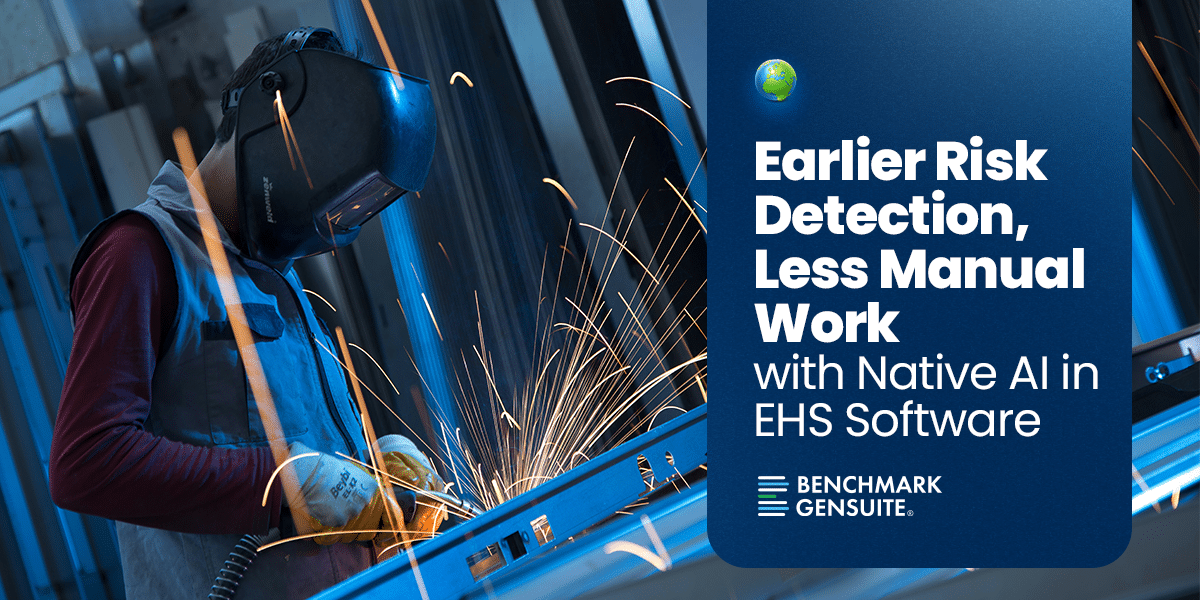
Native AI works inside the platform and records teams already use. It changes daily work in three ways: earlier risk detection, better data behind decisions, and less manual work in investigations, audits and reporting.
Verdantix puts it plainly: “AI has rapidly become the dominant force shaping competition in the EHS software market.” In its 2026 Green Quadrant, it names Benchmark Gensuite a Leader and credits it among the first-mover vendors behind early AI innovation. It also lists Benchmark Gensuite as an example vendor in ten of the eleven AI use cases it maps.
What EHS Buyers Want From AI Today
Verdantix finds that AI is becoming a standard requirement in software de medio ambiente, seguridad y salud evaluations, especially virtual assistants, conversational search, AI-assisted investigations and automated recommendations. Vendor ambitions around autonomous agents often run ahead of what most buyers prioritize today. Verdantix expects that gap to narrow within two years.
That sets a practical standard: deliver results now and build for what comes next. Benchmark Gensuite’s Genny AI follows it in two tiers. IA operativa works inside daily workflows. Agentic AI, including Permit Agent, Chem Agent and Disclosure Agent, runs multi-step programs with human oversight.
Why an Intelligence Layer Is the Practical Way to Implement AI
Verdantix sees leading vendors converging on “an AI-powered ‘intelligence layer’ that underpins all EHS processes.” Three advantages make that the practical path:
- One platform to govern and scale. Security, access and oversight sit in one place, not one tool per use case.
- Más contexto. AI that sees incidents, inspections, actions and training in one record can recommend what a standalone tool cannot.
- No need for new tools. The AI appears inside the platform your team already uses. There is no separate login for people and no extra integration for IT to build or maintain.
Buyers are already testing for this in evaluations. Verdantix reports that platform architecture and scalability are now key RFP discussion points, and that buyers expect incidents, audits, training records and actions to be linked. Their AI concerns have also shifted toward accuracy, transparency and auditability. In our view, those are easier to address when AI runs inside one governed platform.
Here is how that looks, from the enterprise view to the individual task.
- Across the Enterprise: See Risk Earlier
A leader may support many sites, each with its own incidents, inspections and near misses. Patterns that matter, like a recurring condition or a cluster of small events that precede a serious injury, are hard to see from inside any one site.
Asesor de IA de riesgos monitors incidents, observations and inspections across sites to flag trends and risk precursors. PSI AI Advisor flags incidents that could become serious injuries or fatalities. Verdantix treats both use cases, SIF prediction and trend detection, as mainstream and lists Benchmark Gensuite as an example vendor in each. The people reading those signals still decide what to do.
- At the Site: Better Records, Better Decisions
After a serious incident, a site leader needs answers fast: is the worker okay, is the area safe, and what does the regulation require?
Asesor de IA de Describe-It helps people document incidents and inspections with clear, complete detail from the first entry. Suggestion AI recommends corrective actions based on operational history. Both work from the same record the team already uses, so investigations start with better data and end with more consistent responses. The investigator reviews and decides.
- At the Task: Less Manual Work
At the task level, the gains come from removing steps that sit between people and the work that matters. Much of EHS work still depends on transcribing, retyping and reformatting. Safety Data Sheet libraries run to hundreds of pages. Inspections and audits often start from paper forms or spreadsheets.
Verdantix lists SDS extraction among mainstream AI use cases, with Benchmark Gensuite as an example vendor. Anvl Mobilize turns paper forms, PDFs and spreadsheets, in any language, into digital workflows without coding. Document Summary and Image Analysis help reviewers reach the point faster by previewing long files and describing uploaded photos.
Each step saves minutes. Across a global program, those minutes return as hours for prevention.
Measured by Results, Governed by People
Adoption alone doesn’t show impact, so we track what AI returns to teams. Across subscribers, Benchmark Gensuite counts more than 355,000 completed Genny AI interactions from FY25 through FY26 year to date. Modeled at 7.5 minutes saved each, that equals an estimated 44,403 hours, or about 21 full-time employees at 2,080 productive hours per FTE.
Time saved matters only if people trust the output. Genny AI is built with human oversight and governance inside the platform, so people review recommendations and make the decisions. As our CEO R Mukund puts it, “AI supports execution, judgment remains human.”
The AI landscape will keep moving, and the platform is built to move with it. Agentic AI, including Permit Agent, extends the same platform to multi-step programs with human oversight. The MCP Connector, now in pilot and early access, lets AI agents work with records in six demonstrated applications, with read and write scope varying by application.
Three Questions to Ask of Any EHS AI
With AI now standard across EHS software, the comparison that matters is how it behaves in the work. Verdantix’s evaluation points the same way. It asked each vendor which AI use cases are live in production. It also asked how customers can audit, monitor and restrict AI outputs.
Those questions turn into three tests for any demo:
- Where does it work? Inside the records and workflows your team already uses, or in a separate tool?
- What does it carry forward? Does what it learns at one step inform the next?
- Who decides? Can your people see what the AI did and make the call?
AI earns its place in EHS when it makes risk easier to see and routine work easier to finish. People still decide. That is the standard we build Genny AI to meet, and the one we invite you to hold us to.